While I'm on the subject of chickens... In the past six months I've learned some things about chook psychology.
During the day time, chooks seem to like resting on the ground, especially in the dirt, but they want a good long view at ground level - presumably so they can see any potential dangers coming. Ideal spots include hedges and low shrubs. Cool, loose dirt or leaf litter provide comfort, interest and sometimes a hidden snack.
At night it's a different story. Chooks want to climb as high as they can get and will go to extraordinary lengths to find a good perch. I guess the logic is that when it's dark they can't see things coming to eat them, so they might as well just try and get out of the way. Chickens aren't smart at the best of times but once the sun goes down their brain really switches off. They'll flap and squark like crazy if you pick 'em up while sleeping, but they'll go right back to sleep wherever you put 'em down. If they haven't been eaten everything must be OK. Funniest thing is when their head slips out from under their wing and hangs down limp below the level of their feet.
All of that is useful when you're thinking about building a home for chickens. This day/night dichotomy is why I'm trusting a four-foot-high wire fence to keep out chickens which even with clipped wings made it up onto a six-foot fence to sleep. Fingers crossed.
Showing posts with label design. Show all posts
Showing posts with label design. Show all posts
Saturday, 31 January 2009

Wednesday, 21 May 2008
A proposal for a means-tested PVRP
Following up on the previous post, this one explores some options for the design of a solar photovoltaic rebate program. Hopefully a better one than what we have in the real world today.
First let's look at the goals of the program. Overall, the intention is to invest a fixed amount of money over a fixed time period into the PV industry. There are a number of anticipated benefits for society as a whole:
- Develop the skills and infrastructure required for a sustainable PV industry
- Encourage R&D for technology improvement
- Put downward pressure on costs
- Improve competitiveness and effectiveness of PV in the long term
I would also like to throw my own goal in there (to nobody's surprise), encouraging overall reduced energy consumption in participating homes.
Now, the only reason I'm writing this is because I'm critical of the previous attempts on both sides of politics to implement this scheme. Specifically:
- A fixed rebate value skews investment heavily towards the smallest eligible system
- A fixed rebate value without a means test is socially inequitable
- An all-or-nothing means test is more equitable on average but introduces ridiculous boundary cases
- With or without the means test, the scheme ignores the number of residents in the household
The number of residents in the household is important for several reasons. In a scheme where a means test is imposed, surely the case of a single person living alone earning a hundred grand should be considered differently to a working couple with children making do on the same amount. Also, one of the factors involved in choosing whether to purchase a PV system is the amount of time it'll take to recoup the costs, and that gets us back to the topic of feed-in-tariffs. Under the import/export models being adopted by the states it's clearly easier for the single person to generate excess energy than it is for the family.
So I propose that a good rebate scheme would be variable. Different amounts should be paid in different circumstances, according to some reasonable criteria. The scheme should offer greater assistance to those with the greater need, but in all cases part of the cost must be borne by the recipients. Good in principle... but tricky to deliver. Here we go.
First I would suggest that the number of household residents be taken into account when evaluating "means". The simplest way is to divide the household income by the number of residents to work out an income-per-person figure. The single guy mentioned earlier scores $100K, the family of four comes in at $25K each. We'll come back to that in a bit.
My next proposal is that the maximum value of the rebate per household should also be relative to the number of persons. That is, a household with more people should be eligible for more rebate. However there's a risk here that providing funds too freely will encourage profit-taking in the installation industry, and this needs to be addressed.
One way to do this is to also tie the maximum applicable rebate to the generating capacity of the system being installed. We start by nominating a minimum "per-person generating capacity" figure - I'll choose 500W for convenience. Then in order to receive the full rebate for each of the four members of the family household, a system with at least 2000W rated output must be installed. If the family decided to install only a 1000W system, they would be eligible for only half as much rebate. (I hope that makes sense - I'll do some examples at the end.)
Now we need to work out the maximum rebate each person would be eligible to receive. The simplest way to do this is on a linear scale: we need to define the maximum value of the rebate and the upper limit of per-person income at which point the rebate reduces to zero. In keeping with the existing scheme, let's set the maximum rebate to $8,000 and the cut-off at $100K. That means somebody with a "means" of $50K would be eligible for $4,000; somebody worth $75K could get $2,000; and somebody enjoying a hundred grand to themself would get nothing.
Just one more thing. We really don't want to get into the situation where the value of the rebates produces upward pressure on the costs of the PV systems. So let's set an overall threshold which ensures that the household has an incentive to shop around: the total rebate payable shall not exceed 80% of the installed cost of the system.
Simple, huh? No really, it's not that complicated. Here are a couple of examples.
1. Bruce and Sharon live in a house they've bought together. Bruce is a public servant earning $50K while Shazza's cornered the market for organic lima beans and is raking in $100K. Two people in the household, with an average "means" of $75K. The household is therefore eligible for a maximum rebate of $2,000 per person, depending on the size of the array they install. With two people there's really only one option in array size: an entry-level system with a rated output of 1kW makes them eligible for the full $4,000. The best price they can find on such a system is $10,461. Since their maximum rebate is well under 80% of the total price it is paid in full and their net cost is $6,461.
2. Helen, Gary and their four kids somehow manage to get by on the $60K which Gary earns through his small business. With an average "means" of $10K per person, they are each eligible for up to $7,200 in solar rebates - provided sufficient capacity is installed. The maximum rebate would be applicable for a system rated at least 3kW (6 x 500W). Such a system is available for $26,361 - clearly far lower than the hypothetical value of the rebate at $43,200. In this case the 80% rule applies, limiting the rebate to $21,088. Helen and Gary decide they can't afford to spend over $5K even for such a large system, and instead opt for a 1.5kW system that with an 80% rebate leaves them with an outlay of just under $3K.
Some key points to remember. First, I'm just some guy with a few ideas and an internet connection. Don't crucify me if there's something really flawed with my suggestions. Second, there are a number of parameters here which could be adjusted to alter the amount of rebate payable in different circumstances, including the maximum per-person rebate amount, the threshold at which the rebate cuts out completely, the amount of generating capacity required per-person to qualify for that portion of the aggregate rebate and the fractional ceiling limiting the overall rebate as a proportion of the system's cost.
One big weakness I see here is that it's hard to predict how quickly the scheme would burn through its budget allocation. A possible remedy would be to vary the rebate parameters on a periodic basis - probably as part of each year's federal budget.
So there you go. That's enough of that I think.
First let's look at the goals of the program. Overall, the intention is to invest a fixed amount of money over a fixed time period into the PV industry. There are a number of anticipated benefits for society as a whole:
- Develop the skills and infrastructure required for a sustainable PV industry
- Encourage R&D for technology improvement
- Put downward pressure on costs
- Improve competitiveness and effectiveness of PV in the long term
I would also like to throw my own goal in there (to nobody's surprise), encouraging overall reduced energy consumption in participating homes.
Now, the only reason I'm writing this is because I'm critical of the previous attempts on both sides of politics to implement this scheme. Specifically:
- A fixed rebate value skews investment heavily towards the smallest eligible system
- A fixed rebate value without a means test is socially inequitable
- An all-or-nothing means test is more equitable on average but introduces ridiculous boundary cases
- With or without the means test, the scheme ignores the number of residents in the household
The number of residents in the household is important for several reasons. In a scheme where a means test is imposed, surely the case of a single person living alone earning a hundred grand should be considered differently to a working couple with children making do on the same amount. Also, one of the factors involved in choosing whether to purchase a PV system is the amount of time it'll take to recoup the costs, and that gets us back to the topic of feed-in-tariffs. Under the import/export models being adopted by the states it's clearly easier for the single person to generate excess energy than it is for the family.
So I propose that a good rebate scheme would be variable. Different amounts should be paid in different circumstances, according to some reasonable criteria. The scheme should offer greater assistance to those with the greater need, but in all cases part of the cost must be borne by the recipients. Good in principle... but tricky to deliver. Here we go.
First I would suggest that the number of household residents be taken into account when evaluating "means". The simplest way is to divide the household income by the number of residents to work out an income-per-person figure. The single guy mentioned earlier scores $100K, the family of four comes in at $25K each. We'll come back to that in a bit.
My next proposal is that the maximum value of the rebate per household should also be relative to the number of persons. That is, a household with more people should be eligible for more rebate. However there's a risk here that providing funds too freely will encourage profit-taking in the installation industry, and this needs to be addressed.
One way to do this is to also tie the maximum applicable rebate to the generating capacity of the system being installed. We start by nominating a minimum "per-person generating capacity" figure - I'll choose 500W for convenience. Then in order to receive the full rebate for each of the four members of the family household, a system with at least 2000W rated output must be installed. If the family decided to install only a 1000W system, they would be eligible for only half as much rebate. (I hope that makes sense - I'll do some examples at the end.)
Now we need to work out the maximum rebate each person would be eligible to receive. The simplest way to do this is on a linear scale: we need to define the maximum value of the rebate and the upper limit of per-person income at which point the rebate reduces to zero. In keeping with the existing scheme, let's set the maximum rebate to $8,000 and the cut-off at $100K. That means somebody with a "means" of $50K would be eligible for $4,000; somebody worth $75K could get $2,000; and somebody enjoying a hundred grand to themself would get nothing.
Just one more thing. We really don't want to get into the situation where the value of the rebates produces upward pressure on the costs of the PV systems. So let's set an overall threshold which ensures that the household has an incentive to shop around: the total rebate payable shall not exceed 80% of the installed cost of the system.
Simple, huh? No really, it's not that complicated. Here are a couple of examples.
1. Bruce and Sharon live in a house they've bought together. Bruce is a public servant earning $50K while Shazza's cornered the market for organic lima beans and is raking in $100K. Two people in the household, with an average "means" of $75K. The household is therefore eligible for a maximum rebate of $2,000 per person, depending on the size of the array they install. With two people there's really only one option in array size: an entry-level system with a rated output of 1kW makes them eligible for the full $4,000. The best price they can find on such a system is $10,461. Since their maximum rebate is well under 80% of the total price it is paid in full and their net cost is $6,461.
2. Helen, Gary and their four kids somehow manage to get by on the $60K which Gary earns through his small business. With an average "means" of $10K per person, they are each eligible for up to $7,200 in solar rebates - provided sufficient capacity is installed. The maximum rebate would be applicable for a system rated at least 3kW (6 x 500W). Such a system is available for $26,361 - clearly far lower than the hypothetical value of the rebate at $43,200. In this case the 80% rule applies, limiting the rebate to $21,088. Helen and Gary decide they can't afford to spend over $5K even for such a large system, and instead opt for a 1.5kW system that with an 80% rebate leaves them with an outlay of just under $3K.
Some key points to remember. First, I'm just some guy with a few ideas and an internet connection. Don't crucify me if there's something really flawed with my suggestions. Second, there are a number of parameters here which could be adjusted to alter the amount of rebate payable in different circumstances, including the maximum per-person rebate amount, the threshold at which the rebate cuts out completely, the amount of generating capacity required per-person to qualify for that portion of the aggregate rebate and the fractional ceiling limiting the overall rebate as a proportion of the system's cost.
One big weakness I see here is that it's hard to predict how quickly the scheme would burn through its budget allocation. A possible remedy would be to vary the rebate parameters on a periodic basis - probably as part of each year's federal budget.
So there you go. That's enough of that I think.
Saturday, 23 February 2008
Does energy efficiency encourage greater consumption?
My initial encounter with the work of Amory Lovins was everything he intended it to be: persuasive, compelling and inspiring. After watching his lectures it just seemed obvious that we should all be taking energy efficiency to the extreme in order to save heaps of money - not to mention the planet.
Googling about for a bit more info and context, though, it wasn't long before I came across some Lovins hatin'. This piece is a prime example. (The one I linked to - not the one you're reading now!) I know very little about the author, Bryce, and would have to agree with him when it comes to what I believe is the false hope in biofuels, but I really took issue with the last part of his essay where he recalls the work of a long-dead Briton:
Jevons' postulate is based on at least two assumptions: that the available supply of energy will continue to grow over time, and that demand for the service that the energy provides is also unlimited. Think about the context of the early 1800's for a minute, as the industrial revolution was ramping up.
I'm no economist, but I have a notion that around that point in history the main constraint on economic growth was labour productivity - ie how much raw material could be processed by the human (and I guess animal) workforce. Then suddenly, with the invention of the steam engine, the amount of material which could be processed under the direction of one person dramatically increased. Instead of energy from food being applied through muscle, we had energy from wood, coal and other combustibles being applied through machinery.
I don't know exactly what happened, but it seems reasonable to think that the take-up of the new technology would have initially been constrained by high up-front costs, high ongoing costs in terms of fuel and maintenance and the need to train operators. You can also imagine that due to simple economies of scale - and the seemingly unlimited abundance of fossil fuels waiting to be dug out of the ground - both the up-front and ongoing costs would have trended downwards in reasonably quick time.
As that happened, the unit cost of production fell, making a whole range of goods affordable to people who never could have afforded them in the past. A vast reserve of energy converged with a vast reserve of market demand and the end result is the energy-squandering consumerist culture we have today. Any increase in energy efficiency during the time from then until now would simply have lowered production cost and therefore met with increased demand which in turn increased overall energy consumption.
But I suspect that era is rapidly coming to an end.
For starters, we are now seeing constraints on energy availability every way we turn. Even if it weren't for the fact that we've consumed such a large portion of the planet's fossil fuel stores, the greenhouse effect is imposing a major restriction on our use of what remains. Practical, environmental and security concerns get in the way of a rapid expansion of the nuclear power industry. What's left is a smattering of accessible geothermal resources and true renewables like wind, solar and wave energy. For these reasons, I think that energy availability may become the primary constraint on the economy. Increasing energy-efficiency then becomes a pre-requisite for economic growth... but overall energy consumption will be constrained on the supply side. So the first of Jevons' assumptions is no longer true.
The other assumption - that the market will respond to increases in efficiency by simply using more of the service - is more subtle. Let's have another look at what Bryce had to say:
Getting back to Amory Lovins, though, air conditioning is a great point on which to end this post. You see, Lovins doesn't just advocate ongoing marginal improvements to the efficiency of air conditioners and cars. His vision is to design buildings that don't need to use energy to keep them cool, making the air conditioner pretty much obsolete in the process; to make cars which are so light and efficient (while also being roomy, strong and safe) that they can reasonably be powered by solar-generated electricity or a few handfuls of biofuel.
While it's true that our energy supplies are tightening up, the work of guys like Lovins means that there's the opportunity for improving the quality of life by continually learning to do more with less.
Googling about for a bit more info and context, though, it wasn't long before I came across some Lovins hatin'. This piece is a prime example. (The one I linked to - not the one you're reading now!) I know very little about the author, Bryce, and would have to agree with him when it comes to what I believe is the false hope in biofuels, but I really took issue with the last part of his essay where he recalls the work of a long-dead Briton:
The final – and most important – area in which Lovins has been consistently wrong is his claim that efficiency lowers energy consumption. And when it comes to arguing the merits of energy efficiency, Lovins’s prime nemesis is a dead guy – William Stanley Jevons – a British economist who in 1865 determined that increased efficiency won’t cut energy use, it will raise it. “It is wholly a confusion of ideas to suppose that the economical use of fuels is equivalent to a diminished consumption. The very contrary is the truth.” And in the 142 years since Jevons put forth that thesis, now commonly known as the Jevons Paradox, he’s yet to be proven wrong.It shocked and dismayed me at first. Now, after some consideration, I'm convinced that argument is fundamentally flawed when applied to the present day circumstances.
Jevons' postulate is based on at least two assumptions: that the available supply of energy will continue to grow over time, and that demand for the service that the energy provides is also unlimited. Think about the context of the early 1800's for a minute, as the industrial revolution was ramping up.
I'm no economist, but I have a notion that around that point in history the main constraint on economic growth was labour productivity - ie how much raw material could be processed by the human (and I guess animal) workforce. Then suddenly, with the invention of the steam engine, the amount of material which could be processed under the direction of one person dramatically increased. Instead of energy from food being applied through muscle, we had energy from wood, coal and other combustibles being applied through machinery.
I don't know exactly what happened, but it seems reasonable to think that the take-up of the new technology would have initially been constrained by high up-front costs, high ongoing costs in terms of fuel and maintenance and the need to train operators. You can also imagine that due to simple economies of scale - and the seemingly unlimited abundance of fossil fuels waiting to be dug out of the ground - both the up-front and ongoing costs would have trended downwards in reasonably quick time.
As that happened, the unit cost of production fell, making a whole range of goods affordable to people who never could have afforded them in the past. A vast reserve of energy converged with a vast reserve of market demand and the end result is the energy-squandering consumerist culture we have today. Any increase in energy efficiency during the time from then until now would simply have lowered production cost and therefore met with increased demand which in turn increased overall energy consumption.
But I suspect that era is rapidly coming to an end.
For starters, we are now seeing constraints on energy availability every way we turn. Even if it weren't for the fact that we've consumed such a large portion of the planet's fossil fuel stores, the greenhouse effect is imposing a major restriction on our use of what remains. Practical, environmental and security concerns get in the way of a rapid expansion of the nuclear power industry. What's left is a smattering of accessible geothermal resources and true renewables like wind, solar and wave energy. For these reasons, I think that energy availability may become the primary constraint on the economy. Increasing energy-efficiency then becomes a pre-requisite for economic growth... but overall energy consumption will be constrained on the supply side. So the first of Jevons' assumptions is no longer true.
The other assumption - that the market will respond to increases in efficiency by simply using more of the service - is more subtle. Let's have another look at what Bryce had to say:
While it’s true that improvements in energy efficiency on a microeconomic level – like replacing an old inefficient air conditioner with a newer high efficiency one – will cut consumption for that one location, when that same effort is spread over a macro scale the overall energy savings are usually swamped by overall increases in consumption. Thus the installation of more efficient air conditioners across an entire city or state, or country, allows people to use their air conditioners more and, since the cost of cooling suddenly becomes more affordable, more people install air conditioning.OK, that makes sense. It's probably reasonable to say that humanity will find some way to use all of the available energy and there will also be continuing demand for more. But with energy becoming less available, a balance is likely to be found.
Getting back to Amory Lovins, though, air conditioning is a great point on which to end this post. You see, Lovins doesn't just advocate ongoing marginal improvements to the efficiency of air conditioners and cars. His vision is to design buildings that don't need to use energy to keep them cool, making the air conditioner pretty much obsolete in the process; to make cars which are so light and efficient (while also being roomy, strong and safe) that they can reasonably be powered by solar-generated electricity or a few handfuls of biofuel.
While it's true that our energy supplies are tightening up, the work of guys like Lovins means that there's the opportunity for improving the quality of life by continually learning to do more with less.
Tuesday, 22 January 2008
Sustainable Cooking
I've been pondering the issue of energy for cooking - the various energy sources and the technology for using them in the kitchen. Got a few comments and a couple of conclusions to share.
First, burning gas. If we're talking about the fossil fuel kind of gas, I'm opposed to it on the basis that it's a non-renewable, polluting source of energy. Pragmatically speaking it may be an essential part of our transition to sustainability but in the long-term the use of "natural" gas in the kitchen has to stop. I should also mention that in absolute energy terms it's rather inefficient: lots of energy used to extract and transport it, then lots of heat wasted into the air without performing any useful work.
Second, burning wood (or other biomass). In some cases wood is probably the best choice, but I suspect that'll be a minority. Wood is renewable, of course. It's also somewhat polluting especially in areas with dense populations. It's inefficient in terms of being able to direct the heat energy into the cooking but in cold climates that becomes a benefit rather than a problem. Not a good choice for my home though.
Next, solar. Do a web search for "solar oven" and you'll find lots of innovation around the basic theme of using the sun's heat to cook food in an insulated vessel. Absolutely top marks for being clean and sustainable. Not so great for cloudy weather, though, and hard to control in terms of temperature and therefore cooking time. I could imagine this technology becoming more common in the future if other energy systems are struggling to deliver the needs of society... but probably not my own family eating sun-cooked roast veges this coming winter.
Finally, heat from electricity - it's a broad topic. You have to look at both how the electricity is produced and how it is used. The production part of the discussion is well-trodden ground... everybody knows coal is dirty and non-renewable while wind/solar/wave etc offer far cleaner and sustainable sources. No, the really interesting bit is in how the electricity is used.
Most of us have heard that using our microwave oven is a more energy-efficient cooking option than using the standard electric oven or hotplate. That makes sense at first glance. It's not as cut and dried as it sounds, though: consider the case of my own microwave oven.
It's rated at 900W cooking power, which means in theory that it can generate lots of heat directly inside the food instead of heating the materials and air surrounding the food. But if it's putting 900W into the food, why is it drawing 1400W from my AC socket? 500W of power - more than third of the total draw - is being wasted by the machine, lost as heat into my kitchen without touching the food. That's not really very impressive. I've no idea whether other microwave ovens on the market perform any better.
What I do know is that induction cooking is often touted as the safer, more efficient alternative to traditional electric hotplates or gas burners. The technology is vaguely similar to microwave cooking, but instead of using radio waves to transmit energy into the food it uses magnetic fields to transmit energy into the metallic cookware. Proponents like to point out the 85-90% efficiency of converting electrical energy into useful heat (ie heat in the cookware, in contact with the food). Sure beats the 65% that my microwave is capable of.
But I reckon there's an even better electrical cooking technology that's being overlooked. It's cheap, and simple, and already well established in the marketplace. It's your regular old electric frypan. An electric pan has an embedded element which converts 100% of the energy it consumes into heat in the cookware. A portion of that energy is lost as heat radiates away from the pan, but the same could be said of induction cooking technology.
With some simple design improvements - mostly focusing on insulation - highly efficient cooking vessels with embedded electrical heating elements could be the eco-friendly kitchen technology of choice in the future, powered of course using electricity from clean, renewable sources.
First, burning gas. If we're talking about the fossil fuel kind of gas, I'm opposed to it on the basis that it's a non-renewable, polluting source of energy. Pragmatically speaking it may be an essential part of our transition to sustainability but in the long-term the use of "natural" gas in the kitchen has to stop. I should also mention that in absolute energy terms it's rather inefficient: lots of energy used to extract and transport it, then lots of heat wasted into the air without performing any useful work.
Second, burning wood (or other biomass). In some cases wood is probably the best choice, but I suspect that'll be a minority. Wood is renewable, of course. It's also somewhat polluting especially in areas with dense populations. It's inefficient in terms of being able to direct the heat energy into the cooking but in cold climates that becomes a benefit rather than a problem. Not a good choice for my home though.
Next, solar. Do a web search for "solar oven" and you'll find lots of innovation around the basic theme of using the sun's heat to cook food in an insulated vessel. Absolutely top marks for being clean and sustainable. Not so great for cloudy weather, though, and hard to control in terms of temperature and therefore cooking time. I could imagine this technology becoming more common in the future if other energy systems are struggling to deliver the needs of society... but probably not my own family eating sun-cooked roast veges this coming winter.
Finally, heat from electricity - it's a broad topic. You have to look at both how the electricity is produced and how it is used. The production part of the discussion is well-trodden ground... everybody knows coal is dirty and non-renewable while wind/solar/wave etc offer far cleaner and sustainable sources. No, the really interesting bit is in how the electricity is used.
Most of us have heard that using our microwave oven is a more energy-efficient cooking option than using the standard electric oven or hotplate. That makes sense at first glance. It's not as cut and dried as it sounds, though: consider the case of my own microwave oven.
It's rated at 900W cooking power, which means in theory that it can generate lots of heat directly inside the food instead of heating the materials and air surrounding the food. But if it's putting 900W into the food, why is it drawing 1400W from my AC socket? 500W of power - more than third of the total draw - is being wasted by the machine, lost as heat into my kitchen without touching the food. That's not really very impressive. I've no idea whether other microwave ovens on the market perform any better.
What I do know is that induction cooking is often touted as the safer, more efficient alternative to traditional electric hotplates or gas burners. The technology is vaguely similar to microwave cooking, but instead of using radio waves to transmit energy into the food it uses magnetic fields to transmit energy into the metallic cookware. Proponents like to point out the 85-90% efficiency of converting electrical energy into useful heat (ie heat in the cookware, in contact with the food). Sure beats the 65% that my microwave is capable of.
But I reckon there's an even better electrical cooking technology that's being overlooked. It's cheap, and simple, and already well established in the marketplace. It's your regular old electric frypan. An electric pan has an embedded element which converts 100% of the energy it consumes into heat in the cookware. A portion of that energy is lost as heat radiates away from the pan, but the same could be said of induction cooking technology.
With some simple design improvements - mostly focusing on insulation - highly efficient cooking vessels with embedded electrical heating elements could be the eco-friendly kitchen technology of choice in the future, powered of course using electricity from clean, renewable sources.
Wednesday, 16 January 2008
High Tech, Low Power and Less Nasty
I have deliberately kept my work and my blog separate. The high tech company I work for has a very strict policy about the way employees represent it in public and it's a line I never want to cross.
Suffice for me to say, my employer has just released a new model of ultra-portable no-compromise laptop computer. It has a full-size screen and keyboard, runs the full version of our latest operating system, uses a fully modern Intel processor... and according to the published specs has an average power consumption of just 8W. Yes I have a tradition of liking this company's products but that little stat particularly impressed me.
It's also nice to see attention given to things like the materials choices (making use of aluminium for its recycling value, eliminating PVCs and BFRs etc) and packaging (smaller packaging increases transport efficiency, materials also selected for recycling).
And the best thing is that it's not just my employer who's doing this - lots of other companies are making actual improvements in their environmental impact. I wonder how far they can go with it by 2050.
Suffice for me to say, my employer has just released a new model of ultra-portable no-compromise laptop computer. It has a full-size screen and keyboard, runs the full version of our latest operating system, uses a fully modern Intel processor... and according to the published specs has an average power consumption of just 8W. Yes I have a tradition of liking this company's products but that little stat particularly impressed me.
It's also nice to see attention given to things like the materials choices (making use of aluminium for its recycling value, eliminating PVCs and BFRs etc) and packaging (smaller packaging increases transport efficiency, materials also selected for recycling).
And the best thing is that it's not just my employer who's doing this - lots of other companies are making actual improvements in their environmental impact. I wonder how far they can go with it by 2050.
Tuesday, 8 January 2008
Pipes and Pumps, part 3
I've recently stumbled across the controversial figure of Amory Lovins, a high-profile American advocate of radical energy efficiency improvents through integrative design, improved technology and really obvious (once they're pointed out to you) common-sense actions. In March 2007 Lovins gave a series of five evening lectures at Stanford University and these are available for free download as podcasts through iTunes. I found these less than a week after my pump had been installed... and boy did I wish afterwards that those two events had occurred in the opposite order.
In the Tuesday night lecture on improving energy efficiency in industry, Lovins focused fairly heavily on pipes and pumps. Apparently a very large percentage of the electrical energy used by industry is consumed in the motors of pumps. The point is made that due to the compounding energy losses between electrical generation (usually in a coal-fired power station) and consumption in the motor, even a relatively small improvement in end-use efficiency will be multiplied back through the chain to deliver a far more significant drop in generating capacity requirements and associated pollution emissions etc.
In the pursuit of those end-use efficiency improvements, Lovins laid down a number of basic principles for designing energy-efficient pumping systems. I encourage you to watch the lectures for yourself, but my quick summary would have to include:
- If pipework looks neat, it's probably inefficient
- Short, fat, straight pipes are far more efficient than long, thin pipes with corners in them
- Engineers tend to optimise pipes and pumps separately focusing on up-front cost, when an overall cost reduction can be achieved by optimising them as a system for efficiency
- By optimising the efficiency of the system you can specify a much smaller pump which costs far less to buy, run and maintain
- It's usually best to design the pipework *first* and then lay out the equipment around them
That first point especially hit home. Have a look at the pictures in the previous post or two - I actually insisted that the installer do a "proper" job and fit two additional 90-degree bends in the pipe that takes water to the toilet instead of allowing it to curve smoothly (but untidily). I'm quite sure that if I'd watched this lecture beforehand I'd have spent some time carefully designing and specifying the pipes and pump which are going to be a fixture of our home for some years to come.
Oh well. On the bright side, check out the water use stats I'm about to publish in a separate post.
In the Tuesday night lecture on improving energy efficiency in industry, Lovins focused fairly heavily on pipes and pumps. Apparently a very large percentage of the electrical energy used by industry is consumed in the motors of pumps. The point is made that due to the compounding energy losses between electrical generation (usually in a coal-fired power station) and consumption in the motor, even a relatively small improvement in end-use efficiency will be multiplied back through the chain to deliver a far more significant drop in generating capacity requirements and associated pollution emissions etc.
In the pursuit of those end-use efficiency improvements, Lovins laid down a number of basic principles for designing energy-efficient pumping systems. I encourage you to watch the lectures for yourself, but my quick summary would have to include:
- If pipework looks neat, it's probably inefficient
- Short, fat, straight pipes are far more efficient than long, thin pipes with corners in them
- Engineers tend to optimise pipes and pumps separately focusing on up-front cost, when an overall cost reduction can be achieved by optimising them as a system for efficiency
- By optimising the efficiency of the system you can specify a much smaller pump which costs far less to buy, run and maintain
- It's usually best to design the pipework *first* and then lay out the equipment around them
That first point especially hit home. Have a look at the pictures in the previous post or two - I actually insisted that the installer do a "proper" job and fit two additional 90-degree bends in the pipe that takes water to the toilet instead of allowing it to curve smoothly (but untidily). I'm quite sure that if I'd watched this lecture beforehand I'd have spent some time carefully designing and specifying the pipes and pump which are going to be a fixture of our home for some years to come.
Oh well. On the bright side, check out the water use stats I'm about to publish in a separate post.
Saturday, 29 December 2007
Pipes and Pumps, part 2
The good news is that in terms of reducing our use of town water, this project is definitely meeting its objectives! We've done piles of washing and started flushing the loo again with wild abandon. I even hosed off the concrete along the back of the house after doing some top-dressing of the lawn. With the weather we've been having lately (lots of showers) we've been unable to get the water level more than about 1200L below capacity, and as of this morning the tanks were full again. Makes me wish there was some way to use that water for bathing as well.
However... all this water abundance has come at the cost of increased electrical consumption. Of course I knew that some electricity would be necessary to power the pump, but I've discovered two ways in which our setup is far from optimal.
First, the pressure switch. That blue gizmo on top of the pump which monitors the pressure and decides whether the pump needs to be running or not. Courtesy of my power meter I have discovered that the cost of monitoring the pressure is apparently about 15W continuous power consumption, or the equivalent of one rather bright CF bulb shining 24x7. In most homes that would be considered negligible, but in my home that's slightly more than a 5% increase in our average daily energy use.
The obvious solution to problems of that sort is simply to switch off the device when it's not needed. And sure, the pump needs an appropriate switched outlet to plug it into. But that would only solve part of the problem.
Three out of the four taps fed by the pump are used in such a way that it makes sense to switch on the pump before use and switch it off again afterwards - doing a load of washing, filling the tub or a bucket, using the hose and so on. The toilet, though, is a different matter.
With a toilet you need the water to flow into the cistern after your, um, "activity" is completed, and then only for a relatively short time. Can you imagine being required to flush, wash hands, walk to the laundry, flick the switch on, wait 30 seconds then flick the switch off again? Can you imagine teaching young children to do that? No, a simple switch is not going to suffice here.
The next most obvious suggestion is to install a second switch in the toilet, wired up in a 2-way configuration like many light fixtures are - such that flicking either switch up or down will change the on/off status of the light, or pump in this case. It would alleviate the walking part of the problem, but you'd still be left with the waiting.
What I'm hoping to do is a variation on that idea using a logical "OR" operation and a time delay switch. This switch is normally in the "off" state. When you push it in, power is allowed to flow but only for a minute or so until the spring-loaded mechanism returns to its initial position. So you push one button on the cistern to flush the toilet and then another button on the wall to refill the cistern, then you walk away (to wash your hands, of course). Either the laundry switch OR the toilet time delay switch can be independently activated to provide power to the pump as required.
Actually both of those switches will feed into the exterior switched socket that the pump is plugged into, so the correct logical expression is: (laundry OR toilet switch turned on) AND (external switch turned on) -> (a powered pump).
I foolishly bought all three switches today without first asking about the prices. Total cost $106. Could have saved twenty bucks if I hadn't asked for the laundry switch to have one of those little red lights in it to show when it's turned on. But anyway...
At current prices of 21.455 cents per kWh (15.455c regulated tariff 11 plus 6c GreenSwitch renewable energy premium) I'm going to have to have the pump switched OFF for about 33 thousand hours - nearly four years! - to recover the cost of the switches alone. But then I'm still predicting that energy costs will rise rapidly over time, and hopefully these switches will be in use for a long time after they've paid back their cost.
The moral of the story is to carefully check the electrical requirements of the equipment you're installing in a bid to save water. Thus endeth part 2. Next time I'll look at the other, far more important aspect of the energy efficiency equation when it comes to pumping water around: the pipes.
(Got any ideas about how to design a really efficient tank/pump system for home? Please share in the comments.)
However... all this water abundance has come at the cost of increased electrical consumption. Of course I knew that some electricity would be necessary to power the pump, but I've discovered two ways in which our setup is far from optimal.
First, the pressure switch. That blue gizmo on top of the pump which monitors the pressure and decides whether the pump needs to be running or not. Courtesy of my power meter I have discovered that the cost of monitoring the pressure is apparently about 15W continuous power consumption, or the equivalent of one rather bright CF bulb shining 24x7. In most homes that would be considered negligible, but in my home that's slightly more than a 5% increase in our average daily energy use.
The obvious solution to problems of that sort is simply to switch off the device when it's not needed. And sure, the pump needs an appropriate switched outlet to plug it into. But that would only solve part of the problem.
Three out of the four taps fed by the pump are used in such a way that it makes sense to switch on the pump before use and switch it off again afterwards - doing a load of washing, filling the tub or a bucket, using the hose and so on. The toilet, though, is a different matter.
With a toilet you need the water to flow into the cistern after your, um, "activity" is completed, and then only for a relatively short time. Can you imagine being required to flush, wash hands, walk to the laundry, flick the switch on, wait 30 seconds then flick the switch off again? Can you imagine teaching young children to do that? No, a simple switch is not going to suffice here.
The next most obvious suggestion is to install a second switch in the toilet, wired up in a 2-way configuration like many light fixtures are - such that flicking either switch up or down will change the on/off status of the light, or pump in this case. It would alleviate the walking part of the problem, but you'd still be left with the waiting.
What I'm hoping to do is a variation on that idea using a logical "OR" operation and a time delay switch. This switch is normally in the "off" state. When you push it in, power is allowed to flow but only for a minute or so until the spring-loaded mechanism returns to its initial position. So you push one button on the cistern to flush the toilet and then another button on the wall to refill the cistern, then you walk away (to wash your hands, of course). Either the laundry switch OR the toilet time delay switch can be independently activated to provide power to the pump as required.
Actually both of those switches will feed into the exterior switched socket that the pump is plugged into, so the correct logical expression is: (laundry OR toilet switch turned on) AND (external switch turned on) -> (a powered pump).
I foolishly bought all three switches today without first asking about the prices. Total cost $106. Could have saved twenty bucks if I hadn't asked for the laundry switch to have one of those little red lights in it to show when it's turned on. But anyway...
At current prices of 21.455 cents per kWh (15.455c regulated tariff 11 plus 6c GreenSwitch renewable energy premium) I'm going to have to have the pump switched OFF for about 33 thousand hours - nearly four years! - to recover the cost of the switches alone. But then I'm still predicting that energy costs will rise rapidly over time, and hopefully these switches will be in use for a long time after they've paid back their cost.
The moral of the story is to carefully check the electrical requirements of the equipment you're installing in a bid to save water. Thus endeth part 2. Next time I'll look at the other, far more important aspect of the energy efficiency equation when it comes to pumping water around: the pipes.
(Got any ideas about how to design a really efficient tank/pump system for home? Please share in the comments.)
Pipes and Pumps, part 1
Can you think of a more boring-sounding subject? There wouldn't be too many, but if you care about energy and water efficiency then there are some very important things to know about pipes and pumps. As with many lessons in life, I learned these things shortly after the precise moment when it would have been most helpful to know them.
The context is, of course, that having installed tanks to capture the rain that falls on my roof I needed some way to get that water into my laundry and toilet in order to reduce my consumption of externally-supplied water. In this time and place carrying water in buckets is not an acceptable solution. Pipes, valves and a pump would be required. In this post I'll show you the solution we installed.
As I've mentioned more than once, our two tanks are situated one at each end of our house and are connected by a 25mm plastic pipe at ground level. That pipe has two functions: it allows the water level to rise evenly in both tanks regardless of how much water flows through their respective downpipes, and because it runs straight past the laundry it allows water to be drawn evenly from both tanks through a T piece inserted at the appropriate point. So far so good.
Knowing my limits, I paid a professional to supply and install the rest of the solution. We had a brief discussion about my requirements, agreed to use a pump at the low end of the price/performance curve and arranged to install four taps: one on the outside laundry wall adjacent to the pump, two just inside the laundry for the tub and the washing machine and the fourth a few meters along and through the wall for the toilet.
Stop! Camera time. In this first image you can see the inlet (low foreground) going into the pump body (red). On top of the pump is the electric pressure switch (blue) which turns on the pump whenever the outlet pressure drops below a preset level. The water flows upwards through the pressure switch and out the top.

Here you can see the new pipework (black) going up the wall to the new tap (left) and still further up then through the wall into the laundry.

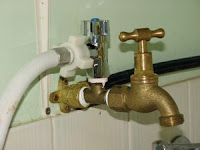
Next, a shot inside the laundry with the double tap arrangement for the tub and washing machine.
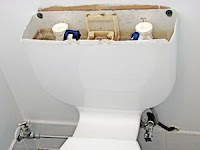
Finally, our modified toilet. My original plan was to have a second tap in the toilet just as we have in the laundry so that we can connect the cistern to the appropriate one as required. The bloke we hired to do the installation explained that council regulations wouldn't allow it - something about making it too difficult for the elderly or the disabled to ensure reliable toilet operation - and so we now have a permanent dual-float configuration where we merely need to turn on the appropriate tap. The tap (and float) on the left control the existing mains water supply while the parts on the right take water from the pump.
Now I shall be the first to admit that, overall, this isn't a "pretty" job - because that really wasn't a goal. The pump gets hidden under a plastic cover that's about the same colour as the concrete, the laundry is destined for eventual renovations anyway and the whole lot is down the back side of the house where nobody goes looking for aesthetic satisfaction.
So that's what it looks like. In the next post I'll go into how well it works.
The context is, of course, that having installed tanks to capture the rain that falls on my roof I needed some way to get that water into my laundry and toilet in order to reduce my consumption of externally-supplied water. In this time and place carrying water in buckets is not an acceptable solution. Pipes, valves and a pump would be required. In this post I'll show you the solution we installed.
As I've mentioned more than once, our two tanks are situated one at each end of our house and are connected by a 25mm plastic pipe at ground level. That pipe has two functions: it allows the water level to rise evenly in both tanks regardless of how much water flows through their respective downpipes, and because it runs straight past the laundry it allows water to be drawn evenly from both tanks through a T piece inserted at the appropriate point. So far so good.
Knowing my limits, I paid a professional to supply and install the rest of the solution. We had a brief discussion about my requirements, agreed to use a pump at the low end of the price/performance curve and arranged to install four taps: one on the outside laundry wall adjacent to the pump, two just inside the laundry for the tub and the washing machine and the fourth a few meters along and through the wall for the toilet.
Stop! Camera time. In this first image you can see the inlet (low foreground) going into the pump body (red). On top of the pump is the electric pressure switch (blue) which turns on the pump whenever the outlet pressure drops below a preset level. The water flows upwards through the pressure switch and out the top.

Here you can see the new pipework (black) going up the wall to the new tap (left) and still further up then through the wall into the laundry.

Next, a shot inside the laundry with the double tap arrangement for the tub and washing machine.

Finally, our modified toilet. My original plan was to have a second tap in the toilet just as we have in the laundry so that we can connect the cistern to the appropriate one as required. The bloke we hired to do the installation explained that council regulations wouldn't allow it - something about making it too difficult for the elderly or the disabled to ensure reliable toilet operation - and so we now have a permanent dual-float configuration where we merely need to turn on the appropriate tap. The tap (and float) on the left control the existing mains water supply while the parts on the right take water from the pump.

Now I shall be the first to admit that, overall, this isn't a "pretty" job - because that really wasn't a goal. The pump gets hidden under a plastic cover that's about the same colour as the concrete, the laundry is destined for eventual renovations anyway and the whole lot is down the back side of the house where nobody goes looking for aesthetic satisfaction.
So that's what it looks like. In the next post I'll go into how well it works.
Friday, 21 September 2007
Money and power
This past week has had a fairly clear theme for me: the price of energy. There's the record-breaking crude oil prices, a discussion at our BNCWAG meeting about the confusing options for buying renewable electricity and then of course the replacement of our hot water system with a solar one.
Lets leave the oil issue alone for the moment (partly because the record prices are being kicked along by a weak US dollar which reduces the significance of the raw numbers). Just now I'm more interested in the electricity market.
Here in Queensland the energy market is regulated. There are fixed tariffs for the supply of electricity to various types of customers for various purposes. Most homes have two circuits: one which supplies electricity for general domestic purposes 24 hours a day for roughly 15c per kWh, and another which typically is connected to a water heater but only works during off-peak hours and is billed at a much lower rate (as low as about 6.5c per kWh).
These prices are the new ones, following an increase at the start of July which was largely attributed to the rising cost of producing electricity with cooling water being in short supply due to the drought. Ironically the drought conditions have led to a significant reduction in shower times and a corresponding reduction in the amount of water heating required. My most recent figures have us averaging 7.3kWh per day this winter at a cost of around 47c.
Now here's the bit which is bugging me. If my shiny new solar hot water system was so good that it never needed any electrical boosting (it's not), and assuming that we required that same amount of heating all year round (we don't), it would take just shy of 30 years for us to recoup the cost of the new unit from the savings on our electricity bills.
I can imagine my wife's raised eyebrow and my father's shaking head about now. But even having run these numbers I would still make the same decision again. It's only bugging me because it makes it harder to convince other people that it's a decision they'd want to make too. There are three reasons I want to point out here.
1. This is mostly about saving energy, not money
The pursuit of short-term economic advantage is what led to our current dirty coal infrastructure and is what maintains the hegemony of the coal industry in Australia's energy industry.
The reason that electricity is available at less than half price overnight is that the massive steam turbines in the coal-fired power plants cannot be switched on and off in a daily cycle. The operators of these plants need to smooth out the demand curve over the course of the day and these skewed pricing arrangements help them achieve that by encouraging additional energy consumption during the night.
It works too: this past quarter my water heater used more energy than everything else in the rest of the house combined! Though it will reduce our bill by less than 30% and at these prices will never pay for itself, installing a solar hot water system is going to approximately halve our total electricity consumption.
2. Electricity prices are likely to rise sharply - even for dirty coal.
There are a number of pressures on the electricity market which I suspect will cause prices to rise sharply over the next couple of decades. If you forgot about sustainability concerns completely you'd still have decreasing availability of cooling water, increasing global demand for coal, increasing local demand for electricity and the need for infrastructure work on generation and transmission.
Now I do hope that the sustainability and environmental agenda is going to have a powerful influence on future policy and development. This would lead to greater reliance on wind and other renewables which have a lower overall capacity, generally higher cost (than the present price of coal where many costs are subsidised or simply not accounted for) and a different delivery profile (solar, for example, is obviously linked to daily cycles).
All in all I expect the price of a unit of energy for the end user like you and me is going nowhere but up. Hopefully through a range of efficiency measures we can keep our overall costs from rising. My Solahart might turn out to be an economic winner in the future.
3. It's in keeping with the philosophy of sustainable design
I keep thinking back to McDonough's work on architecture and building design and his philosophy of making the best use of the available natural resources. Without the solar water heater up there the sunlight's energy would be wasted. My vision for the future is nowhere near as vivid as McDonough's but I'm quite certain that I'd expect to see solar heating in a place like Brisbane.
Lets leave the oil issue alone for the moment (partly because the record prices are being kicked along by a weak US dollar which reduces the significance of the raw numbers). Just now I'm more interested in the electricity market.
Here in Queensland the energy market is regulated. There are fixed tariffs for the supply of electricity to various types of customers for various purposes. Most homes have two circuits: one which supplies electricity for general domestic purposes 24 hours a day for roughly 15c per kWh, and another which typically is connected to a water heater but only works during off-peak hours and is billed at a much lower rate (as low as about 6.5c per kWh).
These prices are the new ones, following an increase at the start of July which was largely attributed to the rising cost of producing electricity with cooling water being in short supply due to the drought. Ironically the drought conditions have led to a significant reduction in shower times and a corresponding reduction in the amount of water heating required. My most recent figures have us averaging 7.3kWh per day this winter at a cost of around 47c.
Now here's the bit which is bugging me. If my shiny new solar hot water system was so good that it never needed any electrical boosting (it's not), and assuming that we required that same amount of heating all year round (we don't), it would take just shy of 30 years for us to recoup the cost of the new unit from the savings on our electricity bills.
I can imagine my wife's raised eyebrow and my father's shaking head about now. But even having run these numbers I would still make the same decision again. It's only bugging me because it makes it harder to convince other people that it's a decision they'd want to make too. There are three reasons I want to point out here.
1. This is mostly about saving energy, not money
The pursuit of short-term economic advantage is what led to our current dirty coal infrastructure and is what maintains the hegemony of the coal industry in Australia's energy industry.
The reason that electricity is available at less than half price overnight is that the massive steam turbines in the coal-fired power plants cannot be switched on and off in a daily cycle. The operators of these plants need to smooth out the demand curve over the course of the day and these skewed pricing arrangements help them achieve that by encouraging additional energy consumption during the night.
It works too: this past quarter my water heater used more energy than everything else in the rest of the house combined! Though it will reduce our bill by less than 30% and at these prices will never pay for itself, installing a solar hot water system is going to approximately halve our total electricity consumption.
2. Electricity prices are likely to rise sharply - even for dirty coal.
There are a number of pressures on the electricity market which I suspect will cause prices to rise sharply over the next couple of decades. If you forgot about sustainability concerns completely you'd still have decreasing availability of cooling water, increasing global demand for coal, increasing local demand for electricity and the need for infrastructure work on generation and transmission.
Now I do hope that the sustainability and environmental agenda is going to have a powerful influence on future policy and development. This would lead to greater reliance on wind and other renewables which have a lower overall capacity, generally higher cost (than the present price of coal where many costs are subsidised or simply not accounted for) and a different delivery profile (solar, for example, is obviously linked to daily cycles).
All in all I expect the price of a unit of energy for the end user like you and me is going nowhere but up. Hopefully through a range of efficiency measures we can keep our overall costs from rising. My Solahart might turn out to be an economic winner in the future.
3. It's in keeping with the philosophy of sustainable design
I keep thinking back to McDonough's work on architecture and building design and his philosophy of making the best use of the available natural resources. Without the solar water heater up there the sunlight's energy would be wasted. My vision for the future is nowhere near as vivid as McDonough's but I'm quite certain that I'd expect to see solar heating in a place like Brisbane.
Sunday, 22 July 2007
I have worms
Funny thing: you buy a "Can-O-Worms" but the worms are sold separately. But anyway, as of yesterday I have one of the first and around a thousand of the second, and a hundred and ten fewer dollars in my bank account. That's eleven cents per worm.
The worm farm itself deserves a bit of a plug, I think. For starters it appears to be a really good design. It has legs, a fluid collection base with tap, three "working trays" and a lid. The theory is that when the top tray gets full the bottom tray will contain heaps of fertiliser and very few worms so you just empty the bottom one and then place it at the top. As you add food to the top the worms come up through the holes and begin creating more fertiliser there. Round and round it goes.
It is made of plastic, but it's made of 100% post-consumer recycled plastic. As with my decision to use concrete blocks as part of the base for my water tanks, I think it's an appropriate use of materials. It's hard to imagine something like this being made from anything other than plastic or metal - of which plastic seems like the less wasteful choice. We do have an enormous amount of existing plastic which would otherwise be headed for a landfill. And unlike many other plastic products this one's designed to perform a valuable function over a long period of time.
Moreover, it's made in Australia and there's very little packaging to be "disposed of" after the purchase. You can check out the model I bought here.
Worms are sold separately, as I mentioned. I grabbed a box of a thousand from the shelf right next to the Can-O-Worms. Good thing, too - it turns out that a thousand worms is the minimum recommended number for starting a worm farm. The worms aren't loose in the box, they're buried in a lump of moist, compost-y black stuff which you just place as-is into the worm farm. Once they've eaten through all the tasty parts of that they will, I understand, squirm up through the holes into the next tray in search of the food scraps I've laid out for them.
For the time being they seem content to stay in the bottom tray in their black stuff. Just to prove I'm not making all this up, here's a pic I snapped late this afternoon.

The worm farm itself deserves a bit of a plug, I think. For starters it appears to be a really good design. It has legs, a fluid collection base with tap, three "working trays" and a lid. The theory is that when the top tray gets full the bottom tray will contain heaps of fertiliser and very few worms so you just empty the bottom one and then place it at the top. As you add food to the top the worms come up through the holes and begin creating more fertiliser there. Round and round it goes.
It is made of plastic, but it's made of 100% post-consumer recycled plastic. As with my decision to use concrete blocks as part of the base for my water tanks, I think it's an appropriate use of materials. It's hard to imagine something like this being made from anything other than plastic or metal - of which plastic seems like the less wasteful choice. We do have an enormous amount of existing plastic which would otherwise be headed for a landfill. And unlike many other plastic products this one's designed to perform a valuable function over a long period of time.
Moreover, it's made in Australia and there's very little packaging to be "disposed of" after the purchase. You can check out the model I bought here.
Worms are sold separately, as I mentioned. I grabbed a box of a thousand from the shelf right next to the Can-O-Worms. Good thing, too - it turns out that a thousand worms is the minimum recommended number for starting a worm farm. The worms aren't loose in the box, they're buried in a lump of moist, compost-y black stuff which you just place as-is into the worm farm. Once they've eaten through all the tasty parts of that they will, I understand, squirm up through the holes into the next tray in search of the food scraps I've laid out for them.
For the time being they seem content to stay in the bottom tray in their black stuff. Just to prove I'm not making all this up, here's a pic I snapped late this afternoon.

Bricks it is, then.
Besser blocks model 15.01, to be precise. 40cm long, 15cm wide, 20cm high. Six of them to a side on three sides, the fourth side being the edge of the concrete apron around the house. 18 per tank site, 36 blocks in all, delivered for $156.20. About the same price as the equivalent quantity of pine sleepers soaked in copper, chrome and arsenic.
They were delivered late yesterday and today I spent a few hours sculpting the trench in which the first six of them now sit. I say "sculpting" because below the turf in my back yard is a whole lot of very dense clay. Using my 150mm spade and a mini-mattock I carved out a surprisingly neat rectangular slot. The blocks went in with a little clay soil packed into the slight gaps along the long sides. The goal is to build a nice rigid wall that will hold a base of crusher dust firmly in place beneath a five tonne water tank. The clay is so solid I'll probably not use any additional concrete to bed the blocks as I had planned.

If it takes a few hours to get one side done, I have an awful lot of hard work remaining. It would have been so much easier just to pour two slabs of concrete - and probably cheaper given that I have a builder, an underground cable layer and a concreter as neighbours. Why the heck am I spending my weekends scratching about in the clay?
The primary environmental concern with concrete is the energy used in manufacturing cement. I read somewhere yesterday that 8% of the world's anthropogenic (man-made) greenhouse gas emissions result directly from the production and use of cement. Scary, if it it's true. But concrete is such a practical building material I can understand its appeal: even mixing by hand I could have poured two slabs in an afternoon, and they would easily outlast the tanks they'd be supporting.
In the end I compromised. I needed something heavy, strong and durable for the border; needed to prevent termite damage to my home; wasn't keen on the copper-chrome-arsenic approach. Pre-formed concrete bricks are going to do the job nicely, are non-toxic, and would probably be re-usable in the future if I ever had reason to take them out of the ground. I think it's an acceptable use of resources.
As added bonuses, I've had my kids out "working" with me, I've performed some much-needed physical exercise, and so long as it turns out OK I'll have the satisfaction of knowing I did it with my own hands.
They were delivered late yesterday and today I spent a few hours sculpting the trench in which the first six of them now sit. I say "sculpting" because below the turf in my back yard is a whole lot of very dense clay. Using my 150mm spade and a mini-mattock I carved out a surprisingly neat rectangular slot. The blocks went in with a little clay soil packed into the slight gaps along the long sides. The goal is to build a nice rigid wall that will hold a base of crusher dust firmly in place beneath a five tonne water tank. The clay is so solid I'll probably not use any additional concrete to bed the blocks as I had planned.

If it takes a few hours to get one side done, I have an awful lot of hard work remaining. It would have been so much easier just to pour two slabs of concrete - and probably cheaper given that I have a builder, an underground cable layer and a concreter as neighbours. Why the heck am I spending my weekends scratching about in the clay?
The primary environmental concern with concrete is the energy used in manufacturing cement. I read somewhere yesterday that 8% of the world's anthropogenic (man-made) greenhouse gas emissions result directly from the production and use of cement. Scary, if it it's true. But concrete is such a practical building material I can understand its appeal: even mixing by hand I could have poured two slabs in an afternoon, and they would easily outlast the tanks they'd be supporting.
In the end I compromised. I needed something heavy, strong and durable for the border; needed to prevent termite damage to my home; wasn't keen on the copper-chrome-arsenic approach. Pre-formed concrete bricks are going to do the job nicely, are non-toxic, and would probably be re-usable in the future if I ever had reason to take them out of the ground. I think it's an acceptable use of resources.
As added bonuses, I've had my kids out "working" with me, I've performed some much-needed physical exercise, and so long as it turns out OK I'll have the satisfaction of knowing I did it with my own hands.
Sunday, 15 July 2007
Renovating for water-efficiency
We bought this place and moved in almost two years ago with the intention of staying for at least twenty. Location, size and price were the key criteria. Water and energy efficiency were not even on the list - if they were we might have chosen not to buy this one.
This post is a bit of a look at the physical attributes of our house in relation to water efficiency and the improvements we're in the process of installing.
 The building is basically rectangular with the top edge in this image facing just slightly east of north. It's about 22m long with no eaves at the ends, and about 9m wide including the eaves along each side. Were it a complete rectangle it'd be almost exactly 200 square meters of catchment area.
The roof has a single centre line running the length of the building and falling away to the east and west. There are five downpipes for stormwater drainage - one at each of the corners along the long sides. It doesn't make sense to try and get the water to flow just to one end of the house so two tanks are needed if all the run-off is to be captured. Since I don't have room to install tanks half way up each side of the house, the only alternative is to put them at each end and install pipes to bring the water around the corners.
Siting the tanks was made more difficult by the 1m concrete apron which runs completely around the house. Early ideas involved a new concrete slab which partly overlapped the apron but my more recent preference towards using crushed rock for the base pushed them that meter away. That in turn had an impact on designs for the stormwater pipes which need to be high enough for people to walk safely underneath. In the end they'll be positioned as per the image: it's a compromise between the practical and aesthetic challenges of running the pipes as well as the limits on available space.
 The tanks we chose are 5000L each, calculated to hold approximately one month's worth of rainfall in an "average" year. They're made of plastic with a ten year guarantee and I hope to extend their life as much as possible by shading them from direct sunlight. At 2.2m diameter they're only 1.6m tall in the centre and about 1.3m at the inlet. An internal first-flush diverter (it has a dedicated drainage outlet at the side of the tank) will reduce contamination from dust and debris and the inlet filter is designed to take the weight of a child without breaking.
Up until recently (when I was writing up a comment on another blog) I had envisaged using one tank solely for gardening and the other for washing clothes and flushing the toilet. But after realising that Julie's tank, half the size of mine and with comparable inflow expectations, would make available something like 160L/day just for the garden I had to reconsider that approach. Our block is flat so I'm now looking at installing a permanent hose between ground-level outlets on each tank: this will allow the two tanks to function as a single 10kL reservoir.
In order to supply the toilet (thankfully there is just one, dual-flush) and the washing machine the plan is to install a small electric pump and two new taps - one in the toilet, one in the laundry. We'll manually attach the hoses to those taps when there's water available in the tanks, and manually switch them over to the town water supply when the tanks are running low. Doing this should avoid any problems with backflow or pressure and makes a top-up valve unnecessary. Both rooms are on the western side roughly two-thirds up.
If the tanks do end up linked together it would probably make sense to install an external pump-powered tap at the northern end near the gardens. And a tap over the laundry sink might be smart as a way to access tank water for other internal uses like filling our gravity-fed water filter or even just mopping the floor.
So after all of that, our two remaining consumers of town water will be the kitchen with its dishwasher and the bath and shower. We'll still be drawing some water from the river systems but hopefully the rain that does fall on our heads will be put to some use instead of being channelled straight out to sea.
Finally I ought to mention cost. A combination of Brisbane City Council and Queensland Government rebates worth $1,850 are applicable to this little project. The only expense so far has been the tanks themselves at about $2,600. I have another thousand dollars set aside to pay for materials, a pump, an electrician and a plumber... though I'm not entirely confident that's going to be enough.
This post is a bit of a look at the physical attributes of our house in relation to water efficiency and the improvements we're in the process of installing.
 The building is basically rectangular with the top edge in this image facing just slightly east of north. It's about 22m long with no eaves at the ends, and about 9m wide including the eaves along each side. Were it a complete rectangle it'd be almost exactly 200 square meters of catchment area.
The roof has a single centre line running the length of the building and falling away to the east and west. There are five downpipes for stormwater drainage - one at each of the corners along the long sides. It doesn't make sense to try and get the water to flow just to one end of the house so two tanks are needed if all the run-off is to be captured. Since I don't have room to install tanks half way up each side of the house, the only alternative is to put them at each end and install pipes to bring the water around the corners.
Siting the tanks was made more difficult by the 1m concrete apron which runs completely around the house. Early ideas involved a new concrete slab which partly overlapped the apron but my more recent preference towards using crushed rock for the base pushed them that meter away. That in turn had an impact on designs for the stormwater pipes which need to be high enough for people to walk safely underneath. In the end they'll be positioned as per the image: it's a compromise between the practical and aesthetic challenges of running the pipes as well as the limits on available space.
 The tanks we chose are 5000L each, calculated to hold approximately one month's worth of rainfall in an "average" year. They're made of plastic with a ten year guarantee and I hope to extend their life as much as possible by shading them from direct sunlight. At 2.2m diameter they're only 1.6m tall in the centre and about 1.3m at the inlet. An internal first-flush diverter (it has a dedicated drainage outlet at the side of the tank) will reduce contamination from dust and debris and the inlet filter is designed to take the weight of a child without breaking.
Up until recently (when I was writing up a comment on another blog) I had envisaged using one tank solely for gardening and the other for washing clothes and flushing the toilet. But after realising that Julie's tank, half the size of mine and with comparable inflow expectations, would make available something like 160L/day just for the garden I had to reconsider that approach. Our block is flat so I'm now looking at installing a permanent hose between ground-level outlets on each tank: this will allow the two tanks to function as a single 10kL reservoir.
In order to supply the toilet (thankfully there is just one, dual-flush) and the washing machine the plan is to install a small electric pump and two new taps - one in the toilet, one in the laundry. We'll manually attach the hoses to those taps when there's water available in the tanks, and manually switch them over to the town water supply when the tanks are running low. Doing this should avoid any problems with backflow or pressure and makes a top-up valve unnecessary. Both rooms are on the western side roughly two-thirds up.
If the tanks do end up linked together it would probably make sense to install an external pump-powered tap at the northern end near the gardens. And a tap over the laundry sink might be smart as a way to access tank water for other internal uses like filling our gravity-fed water filter or even just mopping the floor.
So after all of that, our two remaining consumers of town water will be the kitchen with its dishwasher and the bath and shower. We'll still be drawing some water from the river systems but hopefully the rain that does fall on our heads will be put to some use instead of being channelled straight out to sea.
Finally I ought to mention cost. A combination of Brisbane City Council and Queensland Government rebates worth $1,850 are applicable to this little project. The only expense so far has been the tanks themselves at about $2,600. I have another thousand dollars set aside to pay for materials, a pump, an electrician and a plumber... though I'm not entirely confident that's going to be enough.
Subscribe to:
Posts (Atom)