Two real-life examples of why meters are your friend and reading them is a good idea.
1. "Where did our water go?"
We've had a lot of rain this month. Following a two month stretch during which a total of 26mm fell at our place, we had over 220mm in just five days. That's enough to fill our tanks four times over. With no room for more water, I decided to let any further showers flush out the internal dirty water diverters and opened up the valves. Then promptly forgot about it.
It rained twice more in the following three days: falls of just a few mm but enough that I expected to see the new inflows make up for the water we'd pumped out for the laundry and toilet. But for some reason the gauge didn't go up. In fact it was heading downwards at a surprising rate - around 10cm (800L) in two days. I figured we must have been catching up on a lot of washing.
Two days later we were down another 800L. Something finally triggered my memory - the diverter valves were open! I suddenly recalled that the internal hose which allows the diverter to drain to the outside is not watertight, which means that water from the main chamber can slowly leak out when the drain valve is opened. We must have wasted well over a thousand litres this way.
If I hadn't put a gauge on the tanks and made a habit of checking it, we'd have lost half our supply (the valves are about halfway up the tank wall) within a few more days.
2. "The bill is for how much?!"
A week ago as I sat here working in my home office I noticed somebody briefly inspecting our electrical meter box. "Ah," I thought, "our quarterly electricity bill will be turning up soon." Well turn up it certainly did!
With all that rainy weather I mentioned just before, we had to use the electric booster on our hot water system for a couple of days. Imagine my surprise when the total bill came in at well over twice what I'd been expecting, with an off peak consumption for the quarter of one thousand, five hundred and twenty six kilowatt-hours! The charge for that was almost as much as I'd budgeted for the whole bill.
I hadn't read the meters since a few days before it rained, so I rushed out to check them. After sitting on 90615.3 for about eight months, the off-peak meter today reads... 90638.1. A grand total of 22.8kWh difference.
That's actually more than I'd been hoping to see given how little we used the booster, but it's rather insignificant compared to the matter of the invoice. The meter for the constant supply had also been recorded incorrectly - even today, a week after the reading, I'm still 157kWh short of what they're claiming. It'll take us another 20 days to reach that point.
The lady on the phone conceded that it was a bit odd to have such a spike, although for some reason this bill is recorded as being an "estimated" value. She spent a long time conferring with a supervisor before agreeing that the meter should be re-read. The soonest they could get somebody here would be the 20th (I told them not to rush on my account - I'm in no hurry to get a bill). And she made it sound like she was doing me a favour not charging me the customary $24 fee for a repeat reading (like hell I'm going to pay for them to fix their screw-up).
Ah well, I probably won't be paying too many more bills to that company anyway. I was already looking into switching retailers to get a better rate for the energy my PV panels will produce - 20c instead of 14c per kWh. And once that gear's installed you can bet I'll be watching the new meter closely indeed.
Showing posts with label waste. Show all posts
Showing posts with label waste. Show all posts
Tuesday, 17 June 2008

Saturday, 31 May 2008
More good news about slime
I am frequently critical of "biofuels" technology because of issues like poor (or negative) payback in energy terms and the competition for food production and so on. Once or twice I have mentioned algae as a possible alternative "crop" which may be able to capture solar energy in a chemical form that's suitable for production of liquid fuels. Well, the prospects for a bright slimy green future just got better.
A mob in the US has announced that they have developed a process for producing gasoline from algae, using wastewater to support the algal growth. The key breakthrough is that the fuel they're making is chemically identical to the stuff that we put in our cars today rather than "biodiesel": this makes it a potential direct substitute fuel requiring no change to existing fuel processing and handling systems and no change to our engines.
Of course I'm still going to advocate radical efficiency improvements a la Amory Lovins, but if this technology turns out to be viable and scalable without significant drawbacks then it's going to make a huge difference.
Read more via this link.
About time I could tag a post with "hopes".
A mob in the US has announced that they have developed a process for producing gasoline from algae, using wastewater to support the algal growth. The key breakthrough is that the fuel they're making is chemically identical to the stuff that we put in our cars today rather than "biodiesel": this makes it a potential direct substitute fuel requiring no change to existing fuel processing and handling systems and no change to our engines.
Of course I'm still going to advocate radical efficiency improvements a la Amory Lovins, but if this technology turns out to be viable and scalable without significant drawbacks then it's going to make a huge difference.
Read more via this link.
About time I could tag a post with "hopes".
Wednesday, 16 January 2008
High Tech, Low Power and Less Nasty
I have deliberately kept my work and my blog separate. The high tech company I work for has a very strict policy about the way employees represent it in public and it's a line I never want to cross.
Suffice for me to say, my employer has just released a new model of ultra-portable no-compromise laptop computer. It has a full-size screen and keyboard, runs the full version of our latest operating system, uses a fully modern Intel processor... and according to the published specs has an average power consumption of just 8W. Yes I have a tradition of liking this company's products but that little stat particularly impressed me.
It's also nice to see attention given to things like the materials choices (making use of aluminium for its recycling value, eliminating PVCs and BFRs etc) and packaging (smaller packaging increases transport efficiency, materials also selected for recycling).
And the best thing is that it's not just my employer who's doing this - lots of other companies are making actual improvements in their environmental impact. I wonder how far they can go with it by 2050.
Suffice for me to say, my employer has just released a new model of ultra-portable no-compromise laptop computer. It has a full-size screen and keyboard, runs the full version of our latest operating system, uses a fully modern Intel processor... and according to the published specs has an average power consumption of just 8W. Yes I have a tradition of liking this company's products but that little stat particularly impressed me.
It's also nice to see attention given to things like the materials choices (making use of aluminium for its recycling value, eliminating PVCs and BFRs etc) and packaging (smaller packaging increases transport efficiency, materials also selected for recycling).
And the best thing is that it's not just my employer who's doing this - lots of other companies are making actual improvements in their environmental impact. I wonder how far they can go with it by 2050.
Tuesday, 23 October 2007
Have we sprung a leak!?
In the past couple of months I've allowed the time being readings of the water and electricity meters to stretch out to about once a fortnight. Our consumption of both has been fairly consistent so there didn't seem much point in religiously getting out there every morning.
My previous reading was on the 13th of October and the figures for the preceding 18 days were a little high but nothing extraordinary: 7.3kWh electricity and 347L of water per day.
This morning, ten days later, there's something amiss. Electricity use has dropped back a touch to 6.9kWh per day, but water has shot up to an incredible 507L per day! That's 1.6kL of excess consumption and I just can't imagine where we might have used so much water. Got me wondering about a leak.
The other factor is the new solar water heater: it has a valve which opens under conditions of excess heat/pressure and I'm wondering how much water is being lost that way. I'll go and stick a bucket beneath the outlet (which is a bit of a risk, actually... bucket of really hot water just sitting there...) and try to get a feel for whether it's a significant amount.
Looks like I'll be reading the meters every day for a little while as I try to figure this out.
My previous reading was on the 13th of October and the figures for the preceding 18 days were a little high but nothing extraordinary: 7.3kWh electricity and 347L of water per day.
This morning, ten days later, there's something amiss. Electricity use has dropped back a touch to 6.9kWh per day, but water has shot up to an incredible 507L per day! That's 1.6kL of excess consumption and I just can't imagine where we might have used so much water. Got me wondering about a leak.
The other factor is the new solar water heater: it has a valve which opens under conditions of excess heat/pressure and I'm wondering how much water is being lost that way. I'll go and stick a bucket beneath the outlet (which is a bit of a risk, actually... bucket of really hot water just sitting there...) and try to get a feel for whether it's a significant amount.
Looks like I'll be reading the meters every day for a little while as I try to figure this out.
Monday, 24 September 2007
Free recycling for old computers: Oct 27-29
For my fellow residents of the Brisbane area.
A certain international computer company renowned for making lots of lots of stuff that people want to buy is running a free recycling program around the country for any old computers and related junk. Brisbane's turn is next month with six locations around the city open to take your unwanted stuff.
There are conditions on what's accepted but there are no strings attached. Full details online here.
A certain international computer company renowned for making lots of lots of stuff that people want to buy is running a free recycling program around the country for any old computers and related junk. Brisbane's turn is next month with six locations around the city open to take your unwanted stuff.
There are conditions on what's accepted but there are no strings attached. Full details online here.
Sunday, 26 August 2007
Mulch ado about nothing
If you've read a few of my previous posts you'd hopefully know that I'm strongly in favour of reducing the amount of manufactured goods we purchase, selecting locally-made quality items when it's necessary to buy something and using my own muscles in preference to power tools. But sometimes the practicality of the situation is that you really don't have much choice.
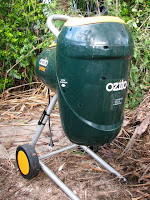 This weekend I bought a mulcher. It was made in China, which is generally considered to have some of the worst industrial practices in the world in terms of environmental impact and social justice. It came in a box with styrofoam, plastic bags and bubble-wrap. Large portions of the product itself are made of plastic which is probably not recyclable. Oh, and it can use as much electricity in about two and half hours as the rest of the house does in a whole day (not counting hot water).
So what was I thinking?
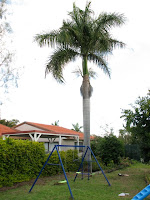 Well there's a lot growing in our back yard including a couple of monster palm trees which drop enormous fronds on a regular basis. We have hibiscus bushes and on three sides a border of sheena's gold, all of which need to be trimmed frequently or they get out of hand. In order to make room for tank #1 I had to remove (by hand) one small tree and while I was at it I removed another (by hand) which had established itself in what is ostensibly the vege garden. Both of the trees, a half dozen fronds and a heap of prunings all piled together were starting to look like a fabulous snake refuge for the coming summer.
In rural areas and in times past, people would simply burn much of this material either as fuel or simply to get rid of it. That's not permitted in cities like Brisbane (for good reason). Here, this material is considered "waste" and so it is subjected to the same general rule which applies for other waste - it gets transported to a central waste transfer station and "processed". If I don't want my garden trimmings rotting in landfill I have to put them in a trailer and drive more than 15 minutes each way to drop them off myself - or pay somebody else to make the trip for me.
But I don't see this material as waste. It's a resource which I want to use here as compost or mulch. I tried for a while stripping the green leaves from the hibiscus prunings by hand so as to make a suitable material for compost, but in the end it just wasn't working. And how am I supposed to manually make mulch from those huge palm fronds?
In a bygone era there might have been mulching machines which could be powered by hand (or foot, or horse... or children). I very much doubt I could track one of those down these days. In the end there wasn't much choice. I had to go with what's available.
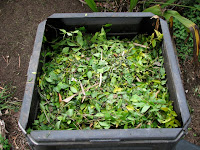
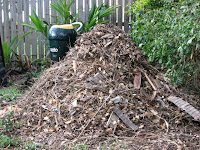
One aspect of the decision was easy: I wanted an electric one rather than something with a petrol engine, because I know I can buy 100% of my electricity from renewable, non-polluting sources. Beyond that it was just a question of choosing something that would get the job done. And I have to say... well actually no, I won't "say" anything. I'll just let the results speak for themselves.
 This weekend I bought a mulcher. It was made in China, which is generally considered to have some of the worst industrial practices in the world in terms of environmental impact and social justice. It came in a box with styrofoam, plastic bags and bubble-wrap. Large portions of the product itself are made of plastic which is probably not recyclable. Oh, and it can use as much electricity in about two and half hours as the rest of the house does in a whole day (not counting hot water).
So what was I thinking?
 Well there's a lot growing in our back yard including a couple of monster palm trees which drop enormous fronds on a regular basis. We have hibiscus bushes and on three sides a border of sheena's gold, all of which need to be trimmed frequently or they get out of hand. In order to make room for tank #1 I had to remove (by hand) one small tree and while I was at it I removed another (by hand) which had established itself in what is ostensibly the vege garden. Both of the trees, a half dozen fronds and a heap of prunings all piled together were starting to look like a fabulous snake refuge for the coming summer.
In rural areas and in times past, people would simply burn much of this material either as fuel or simply to get rid of it. That's not permitted in cities like Brisbane (for good reason). Here, this material is considered "waste" and so it is subjected to the same general rule which applies for other waste - it gets transported to a central waste transfer station and "processed". If I don't want my garden trimmings rotting in landfill I have to put them in a trailer and drive more than 15 minutes each way to drop them off myself - or pay somebody else to make the trip for me.
But I don't see this material as waste. It's a resource which I want to use here as compost or mulch. I tried for a while stripping the green leaves from the hibiscus prunings by hand so as to make a suitable material for compost, but in the end it just wasn't working. And how am I supposed to manually make mulch from those huge palm fronds?
In a bygone era there might have been mulching machines which could be powered by hand (or foot, or horse... or children). I very much doubt I could track one of those down these days. In the end there wasn't much choice. I had to go with what's available.
One aspect of the decision was easy: I wanted an electric one rather than something with a petrol engine, because I know I can buy 100% of my electricity from renewable, non-polluting sources. Beyond that it was just a question of choosing something that would get the job done. And I have to say... well actually no, I won't "say" anything. I'll just let the results speak for themselves.


Friday, 20 July 2007
I declare the Weekend of the Worm
Some things were just meant to be. After my mice-infested compost disaster last weekend I've been exchanging comments with Crazy Mumma (her blog here) about the idea of using worms to process kitchen scraps instead of putting them outside where they become food for vermin instead of plants.
CM gave me a link to some instructions on building your own worm farm on the cheap, and now Colin (aka No Impact Man) has just posted his own DIY worm farm tips as well! There's absolutely no excuse left now.
This weekend I'm getting worms. I dare you to join me! (That means you, CM!)
CM gave me a link to some instructions on building your own worm farm on the cheap, and now Colin (aka No Impact Man) has just posted his own DIY worm farm tips as well! There's absolutely no excuse left now.
This weekend I'm getting worms. I dare you to join me! (That means you, CM!)
Wednesday, 18 July 2007
Vaguely like eBay, but free!
I love it when I have an idea and then discover it's already a reality. Not only does it mean the idea was probably a decent one, but it means I can enjoy it without having to put in the effort of making it happen.
Case in point: Freecycle.
This kind of voluntary community-based recycling via the internet is something I've been idly thinking about over the past couple of weeks. There's a group with 300+ members based in Strathpine (the suburb immediately to the west of where I live) so I've just sent an email off to join up. Hopefully I'll be able to reduce some of the clutter around my place by simply finding better homes for things, and avoid creating "waste" in the process.
Case in point: Freecycle.
"The Freecycle Network™ is made up of many individual groups across the globe. It's a grassroots and entirely nonprofit movement of people who are giving (& getting) stuff for free in their own towns... When you want to find a new home for something -- whether it's a chair, a fax machine, piano, or an old door -- you simply send an e-mail offering it to members of the local Freecycle group. Or, maybe you're looking to acquire something yourself. Simply respond to a member's offer, and you just might get it."
This kind of voluntary community-based recycling via the internet is something I've been idly thinking about over the past couple of weeks. There's a group with 300+ members based in Strathpine (the suburb immediately to the west of where I live) so I've just sent an email off to join up. Hopefully I'll be able to reduce some of the clutter around my place by simply finding better homes for things, and avoid creating "waste" in the process.
Sunday, 15 July 2007
Composting tragedy: a cautionary tale
This is going to be a difficult post to write. It has the potential to be quite disturbing to some people - you probably wouldn't let your kids read this. But it contains an important lesson for anybody interested in composting as a waste reduction strategy.
I wrote yesterday about a couple of different options for suburban composting. I described briefly the open-bottomed black plastic bin which I've been using in my first foray into managed decomposition.
Prompted into effort through the act of blogging (as I tend to be), late this afternoon I set about tending to the pile: turning it, then adding some new material and a bit of water. It's probably not the "right" way to go about things but I'm new to this.
The easiest way to turn a pile that's in a bin like mine is to lift the bin off the top, put it down next to the pile and start putting the pile back into it so that what was on the top ends up on the bottom and vise versa. So far, my compost pile is a mixed bag in terms of original material and current condition. Some of it looks really rich and vital, some is dry or woody. Not surprisingly the earth right at the bottom tends to be dark, moist and rich-looking. Since I'm transferring the pile between the same two locations each time I turn it, I have a habit of digging the shovel in a bit and moving some of that rich soil/compost into the active bin.
Today, that underlying soil was a lot more alive than I'd reckoned on. My shovel's blade went straight into a nest full of young mice.
I had read about the risk of mice or rats being attracted to compost bins. Prior to today I'd not seen any here, but while I was turning the top parts of the pile over two or three had dashed out to safety. I'd felt disappointed but somewhat resigned, and suddenly the neighbour's cat's recent tendency to camp out in this corner of my yard made a lot of sense. With those few out of the way I hadn't for a moment considered there'd be more beneath the ground.
Startled by a nest of vermin, and with some awful injuries already inflicted, my immediate reaction was to end the matter as quickly as possible. I don't know whether it was the right thing to do, and I'm not going to use this post to try and argue it either way, but I hated doing it and have felt sickened by it ever since.
The point of posting about it is to remind you of the obvious: human "wastes" are a rodent's "dinner", and wherever you find people you will also find rats and mice. Recycling our kitchen refuse in a compost bin is a brilliant idea in terms of resource utilisation and efficiency but we're not the only ones interested in those nutrients.
Maybe one of those fancy compost bins I linked to in my earlier post is not such an extravagant idea after all.
I wrote yesterday about a couple of different options for suburban composting. I described briefly the open-bottomed black plastic bin which I've been using in my first foray into managed decomposition.
Prompted into effort through the act of blogging (as I tend to be), late this afternoon I set about tending to the pile: turning it, then adding some new material and a bit of water. It's probably not the "right" way to go about things but I'm new to this.
The easiest way to turn a pile that's in a bin like mine is to lift the bin off the top, put it down next to the pile and start putting the pile back into it so that what was on the top ends up on the bottom and vise versa. So far, my compost pile is a mixed bag in terms of original material and current condition. Some of it looks really rich and vital, some is dry or woody. Not surprisingly the earth right at the bottom tends to be dark, moist and rich-looking. Since I'm transferring the pile between the same two locations each time I turn it, I have a habit of digging the shovel in a bit and moving some of that rich soil/compost into the active bin.
Today, that underlying soil was a lot more alive than I'd reckoned on. My shovel's blade went straight into a nest full of young mice.
I had read about the risk of mice or rats being attracted to compost bins. Prior to today I'd not seen any here, but while I was turning the top parts of the pile over two or three had dashed out to safety. I'd felt disappointed but somewhat resigned, and suddenly the neighbour's cat's recent tendency to camp out in this corner of my yard made a lot of sense. With those few out of the way I hadn't for a moment considered there'd be more beneath the ground.
Startled by a nest of vermin, and with some awful injuries already inflicted, my immediate reaction was to end the matter as quickly as possible. I don't know whether it was the right thing to do, and I'm not going to use this post to try and argue it either way, but I hated doing it and have felt sickened by it ever since.
The point of posting about it is to remind you of the obvious: human "wastes" are a rodent's "dinner", and wherever you find people you will also find rats and mice. Recycling our kitchen refuse in a compost bin is a brilliant idea in terms of resource utilisation and efficiency but we're not the only ones interested in those nutrients.
Maybe one of those fancy compost bins I linked to in my earlier post is not such an extravagant idea after all.
Copper, chrome and arsenic - oh my!
After going back and forth for ages I decided that the tanks would be installed on a bed of crushed rock instead of concrete. Cost was a factor, as was my disinclination to contribute even a few more square meters to the concrete jungle of a modern city. (Future archaeologists probably won't view this as the "information age" the way we romantically project. I think it's more likely to be known as the concrete or plastic age. But I digress...)
One disadvantage of the crushed rock option is that unless is it securely restrained it has a tendency to spread out or erode from the edges. The way I've seen people counter this is to construct a border out of sturdy wooden sleepers to contain the rock.
What I hadn't considered until I was exploring my options at the hardware ubermarket this arvo is that in order to prevent the wood from decaying - that is, being eaten by insects, fungus and bacteria the way all non-living wood naturally is - it has to be soaked in a toxic cocktail of copper, chrome and arsenic. That way the things which try and eat the wood will become sick and die, or if they're smart simply be repelled.
Now I'm having to re-think.
Partly I'm concerned about the potential for toxic effects on my family and I. The jury is officially out on whether there is a measurable risk to human health from the use of "treated" wood such as this, but remember I'm building a water supply which I intend to use on surrounding vegetable gardens. It just doesn't seem like a smart thing to do.
The other part of my concern arises from the "waste equals food" philosophy espoused in the book Cradle to Cradle. This book has had a huge influence on me and now it doesn't seem right to take a perfectly good piece of timber and turn it into something which has a short useful life and then becomes toxic waste.
I may end up pouring concrete after all.
One disadvantage of the crushed rock option is that unless is it securely restrained it has a tendency to spread out or erode from the edges. The way I've seen people counter this is to construct a border out of sturdy wooden sleepers to contain the rock.
What I hadn't considered until I was exploring my options at the hardware ubermarket this arvo is that in order to prevent the wood from decaying - that is, being eaten by insects, fungus and bacteria the way all non-living wood naturally is - it has to be soaked in a toxic cocktail of copper, chrome and arsenic. That way the things which try and eat the wood will become sick and die, or if they're smart simply be repelled.
Now I'm having to re-think.
Partly I'm concerned about the potential for toxic effects on my family and I. The jury is officially out on whether there is a measurable risk to human health from the use of "treated" wood such as this, but remember I'm building a water supply which I intend to use on surrounding vegetable gardens. It just doesn't seem like a smart thing to do.
The other part of my concern arises from the "waste equals food" philosophy espoused in the book Cradle to Cradle. This book has had a huge influence on me and now it doesn't seem right to take a perfectly good piece of timber and turn it into something which has a short useful life and then becomes toxic waste.
I may end up pouring concrete after all.
Sunday, 8 July 2007
The best way to decay
I have a large backyard by local standards. Our property is 900sqm and the house etc would probably only cover around a third of that area. So there are plenty of trees and shrubs competing with a fair swathe of grass for the remaining space, all of which yield a fair amount of what some people call "garden waste".
Inside, we eat fresh fruit and vegetables on a daily basis and are producing a steady stream of "kitchen waste".
But of course it's not waste. It's a resource which I want to convert into natural fertiliser for enriching the soil and growing healthy food.
My neighbour generously provided me with one of those simple black plastic open-bottomed compost bins which he said was "surplus to requirements". For the last couple of months I've been feeding it with material from both the garden and the kitchen, turning it all over occasionally and adding a bit of water now and then. There's certainly something biological going on in there... the volume of material keeps shrinking and at times there have been different kinds of larvae and/or worms visible. But I'm not convinced that what's being produced is anywhere near as useful for fertilising my veges as I was hoping for.
The same neighbour also loaned me a book on composting which suggested that making compost effectively requires a lot of material to be combined in exactly the right proportions all in one go and then carefully tended. It was like baking a soufflé or something. And the fellow who gave the talk on BioChar a few weeks back implied a similar thing when he mentioned that "hot composts" are too hard to do right in a regular-sized back yard.
So what should somebody like me do? What about people with smaller yards, or mere balconies and courtyards? Well here are a few options:
BioChar bloke showed us pictures of a method of "cold composting" he was experimenting with, which involved digging a series of shallow pits which you would fill up one by one with whatever material came to hand before moving on to the next one. The theory is that by the time you filled up the last one the first would have decomposed to a degree which made its contents useful elsewhere in your garden and the cycle could continue from there. It still takes up a fair bit of space but doesn't require any financial investment to get started.
Part of the reason that "hot composts" require so much material and effort is that they need the bulk to produce and retain the heat, and they need frequent turning over to ensure proper aeration. There's a fancy compost bin on the market aimed at the suburban non-gardeners like me which uses a combination of insulation to trap heat and an innovative central air tube to try and get the benefits of hot composting without the effort. And it gets a very positive review (link to PDF) from a reputable Australian gardening club.
If you don't have a garden or a large family to produce enough waste to feed a large bin like that, then a worm farm could be the way to go. I was astonished to find that you can buy not only the farms themselves but also boxes of live worms from my local hardware megastore. These commercial kits are relatively cheap (compared to the fancy compost bin anyway) but I've seen instructions in various places for how you could build your own from relatively common bits and pieces.
Worms produce a different kind of fertiliser to compost, and you have to be a little careful with what you feed them (they really don't like onion or citrus, I hear) but if you're growing in pots on a balcony or in a courtyard it's pretty much an ideal solution.
I'm probably going to persist with my current compost bin for a little longer and see if I can't make anything useful of it. If not... I'm tempted by worms because they're cheap, effective, self-renewing and probably something the kids would enjoy. The fancy bin is attractive but I'm not sure if buying another new plastic thing is really the kind of solution I'm looking for.
Inside, we eat fresh fruit and vegetables on a daily basis and are producing a steady stream of "kitchen waste".
But of course it's not waste. It's a resource which I want to convert into natural fertiliser for enriching the soil and growing healthy food.
My neighbour generously provided me with one of those simple black plastic open-bottomed compost bins which he said was "surplus to requirements". For the last couple of months I've been feeding it with material from both the garden and the kitchen, turning it all over occasionally and adding a bit of water now and then. There's certainly something biological going on in there... the volume of material keeps shrinking and at times there have been different kinds of larvae and/or worms visible. But I'm not convinced that what's being produced is anywhere near as useful for fertilising my veges as I was hoping for.
The same neighbour also loaned me a book on composting which suggested that making compost effectively requires a lot of material to be combined in exactly the right proportions all in one go and then carefully tended. It was like baking a soufflé or something. And the fellow who gave the talk on BioChar a few weeks back implied a similar thing when he mentioned that "hot composts" are too hard to do right in a regular-sized back yard.
So what should somebody like me do? What about people with smaller yards, or mere balconies and courtyards? Well here are a few options:
BioChar bloke showed us pictures of a method of "cold composting" he was experimenting with, which involved digging a series of shallow pits which you would fill up one by one with whatever material came to hand before moving on to the next one. The theory is that by the time you filled up the last one the first would have decomposed to a degree which made its contents useful elsewhere in your garden and the cycle could continue from there. It still takes up a fair bit of space but doesn't require any financial investment to get started.
Part of the reason that "hot composts" require so much material and effort is that they need the bulk to produce and retain the heat, and they need frequent turning over to ensure proper aeration. There's a fancy compost bin on the market aimed at the suburban non-gardeners like me which uses a combination of insulation to trap heat and an innovative central air tube to try and get the benefits of hot composting without the effort. And it gets a very positive review (link to PDF) from a reputable Australian gardening club.
If you don't have a garden or a large family to produce enough waste to feed a large bin like that, then a worm farm could be the way to go. I was astonished to find that you can buy not only the farms themselves but also boxes of live worms from my local hardware megastore. These commercial kits are relatively cheap (compared to the fancy compost bin anyway) but I've seen instructions in various places for how you could build your own from relatively common bits and pieces.
Worms produce a different kind of fertiliser to compost, and you have to be a little careful with what you feed them (they really don't like onion or citrus, I hear) but if you're growing in pots on a balcony or in a courtyard it's pretty much an ideal solution.
I'm probably going to persist with my current compost bin for a little longer and see if I can't make anything useful of it. If not... I'm tempted by worms because they're cheap, effective, self-renewing and probably something the kids would enjoy. The fancy bin is attractive but I'm not sure if buying another new plastic thing is really the kind of solution I'm looking for.
Sunday, 20 May 2007
My real-life hero?
Am experiencing an unfamiliar feeling.
Obviously the term "hero" is nothing new to me. But I don't think I've ever experienced an emotional response to the words or actions of another person such that I would consider them to be my hero. Until perhaps now.
One of the documentaries I mentioned in the previous post was "Waste Equals Food", which featured the ideas and achievements of William McDonough. It was his book, "Cradle to Cradle", which I ordered after watching the film. (Which was at least partly the aim of the film, I'm quite sure.)
And just now I've come across this speech from almost exactly ten years ago.
It's inspirational reading. Mr McDonough might just have become "my" very first hero. Will let you know what I think of the book.
Obviously the term "hero" is nothing new to me. But I don't think I've ever experienced an emotional response to the words or actions of another person such that I would consider them to be my hero. Until perhaps now.
One of the documentaries I mentioned in the previous post was "Waste Equals Food", which featured the ideas and achievements of William McDonough. It was his book, "Cradle to Cradle", which I ordered after watching the film. (Which was at least partly the aim of the film, I'm quite sure.)
And just now I've come across this speech from almost exactly ten years ago.
It's inspirational reading. Mr McDonough might just have become "my" very first hero. Will let you know what I think of the book.
Friday, 18 May 2007
Council responds re fluoro disposal
I mentioned recently that I'd received inconsistent advice from Brisbane City Council regarding the proper disposal of compact fluorescent light bulbs, which contain small amounts of mercury.
Here's the latest word from them on that subject:
Here's the latest word from them on that subject:
Dear Mr Brady,
Thanks for your enquiry - we are aware of the new requirements for the safe disposal of fluorescent light bulbs and we have been investigating a number of options to address recycling of fluorescent tubes and globes. However, because there are are no cost effective fluorescent recycling opportunities in Brisbane, it will take some time to establish one.
Until a recycling service is organised, you should place the globe/tube in your general waste bin. Brisbane's engineered landfill has the capacity to accept the minute quantities of phosfor and mercury and mitigate environmental harm.
We will amend the detail on the website until a recycling service is organised.
Tuesday, 15 May 2007
Time for a Break
(To anybody who thinks I'm going to slow down on the blogging - ha! No way, check out the length of this post!)
You know about my long hot showers. You know about my three-thousand-litres-of-fuel-a-year car. And now it's time for me to 'fess up to another unsustainable aspect of my life...
"My name is Terry, and I'm an Ice Break-oholic."
My Ice Break addiction started in about 1995. Michelle was living adjacent to a cluster of small shops which included a Brumby's bakery and a Night Owl convenience store. We'd long known about the delights of fresh Brumby's blueberry muffins with a coffee as breakfast on a clear Brisbane morning. But this fateful day I was in the mood for a coffee-flavoured milk drink instead of a hot beverage, and an odd-looking brown plastic bottle caught my eye from the shelf adjacent to the usual tetra pack flavoured milk varieties.
Real filtered coffee in a cold milk drink instead of the usual powdered stuff? Yeah, I'd give that a try.
It's hard to say for sure, but since that day I have probably consumed something like five thousand bottles of the stuff. It could easily be more. With the smallest package size being 500ml, we're talking about at least two and a half thousand litres of milk. And well over ten thousand dollars.
Well hey, how I choose to spend my money is mostly my own business. But in the context of sustainable consumption there are some serious problems here. Let's start with the obvious ones.
Firstly there's the milk. Between 500ml and a litre (occasionally, but not often more) of milk each day is probably a lot more than the average. It's generally considered healthy to have some dairy foods in your diet for the sake of calcium, and in fact those of us with European ancestry may owe our existence to the genetic mutation which first allowed people to digest the nutrition in cow's milk. But cows are not native to Australia. Cattle cause substantial damage to our native landscape, and the dairy industry is a significant contributor to greenhouse gas emissions.
The second problem is the packaging. Five thousand plastic bottles, all of them produced from oil, all of them requiring energy for production and again for recycling.
Then there's the transport. It's a fresh milk product, which means it has a very short lifetime in which to travel from the milking shed to my lips. Inevitably this means oil-consuming road transport. Not to mention the coffee, which was itself probably sourced from overseas. (I don't know, I'm just guessing about that.)
Fresh milk also requires constant refridgeration - again using significant amounts of energy which were largely provided by burning coal.
And if that doesn't sound like an inefficient, unsustainable practice... I hang my head in shame to recall the period during which I would drive my car (yes, the six-cylinder one) the kilometer or so down the road to the local shop - every morning! - to purchase the sweet, slightly-caffeinated elixir of life without which my day could start only one way: badly.
Thankfully, that particular practice has been stopped. Shortly after I realised the insanity of what I was doing, I enjoyed a week or so where I would put Josh in the seat on the back of my bike and pedal off to the shop with Caitlin beside me each morning to buy a 750ml bottle which would be my ration for the day. As a family time it was great.
But once I'd started this train of thought I discovered the rails went a lot further than I'd realised. All these bottles... such waste... and so I started planning a little ahead and buying the two litre variety from the supermarket (without making any special trips to do so) and restricting my consumption to the same 750ml per day maximum. The larger bottles are more efficient in several respects including the amount of plastic used, the amount of transport fuel required (they stack more densely than the smaller cylindrical bottles) and of course their impact on my wallet!
Still, by the measuring stick of sustainability, it's much too much. I've tried going cold-turkey a few times in the past. Think I lasted a week once. It wasn't pretty. But I have to do something.
So... (Terry takes a deep breath)... here's my next step: starting tomorrow I'm going to reduce my typical Ice Break consumption by half. Unless I'm out of town, a single 375ml glass per day is my quota. When away from home a single 500ml bottle per day is all that's allowed.
Michelle will be sure to let me know if she sees me failing to adhere to this, and if she does I'll do the right thing and admit it online. That's unless withdrawal symptoms send me totally nuts first.
And just so you know I'm not the most extreme coffee-renouncing sustainability freak on the planet, check out this heart-wrenching post from the wife of the most extreme coffee-renouncing sustainability freak, "No Impact Man" Colin Beavan.
You know about my long hot showers. You know about my three-thousand-litres-of-fuel-a-year car. And now it's time for me to 'fess up to another unsustainable aspect of my life...
"My name is Terry, and I'm an Ice Break-oholic."
My Ice Break addiction started in about 1995. Michelle was living adjacent to a cluster of small shops which included a Brumby's bakery and a Night Owl convenience store. We'd long known about the delights of fresh Brumby's blueberry muffins with a coffee as breakfast on a clear Brisbane morning. But this fateful day I was in the mood for a coffee-flavoured milk drink instead of a hot beverage, and an odd-looking brown plastic bottle caught my eye from the shelf adjacent to the usual tetra pack flavoured milk varieties.
Real filtered coffee in a cold milk drink instead of the usual powdered stuff? Yeah, I'd give that a try.
It's hard to say for sure, but since that day I have probably consumed something like five thousand bottles of the stuff. It could easily be more. With the smallest package size being 500ml, we're talking about at least two and a half thousand litres of milk. And well over ten thousand dollars.
Well hey, how I choose to spend my money is mostly my own business. But in the context of sustainable consumption there are some serious problems here. Let's start with the obvious ones.
Firstly there's the milk. Between 500ml and a litre (occasionally, but not often more) of milk each day is probably a lot more than the average. It's generally considered healthy to have some dairy foods in your diet for the sake of calcium, and in fact those of us with European ancestry may owe our existence to the genetic mutation which first allowed people to digest the nutrition in cow's milk. But cows are not native to Australia. Cattle cause substantial damage to our native landscape, and the dairy industry is a significant contributor to greenhouse gas emissions.
The second problem is the packaging. Five thousand plastic bottles, all of them produced from oil, all of them requiring energy for production and again for recycling.
Then there's the transport. It's a fresh milk product, which means it has a very short lifetime in which to travel from the milking shed to my lips. Inevitably this means oil-consuming road transport. Not to mention the coffee, which was itself probably sourced from overseas. (I don't know, I'm just guessing about that.)
Fresh milk also requires constant refridgeration - again using significant amounts of energy which were largely provided by burning coal.
And if that doesn't sound like an inefficient, unsustainable practice... I hang my head in shame to recall the period during which I would drive my car (yes, the six-cylinder one) the kilometer or so down the road to the local shop - every morning! - to purchase the sweet, slightly-caffeinated elixir of life without which my day could start only one way: badly.
Thankfully, that particular practice has been stopped. Shortly after I realised the insanity of what I was doing, I enjoyed a week or so where I would put Josh in the seat on the back of my bike and pedal off to the shop with Caitlin beside me each morning to buy a 750ml bottle which would be my ration for the day. As a family time it was great.
But once I'd started this train of thought I discovered the rails went a lot further than I'd realised. All these bottles... such waste... and so I started planning a little ahead and buying the two litre variety from the supermarket (without making any special trips to do so) and restricting my consumption to the same 750ml per day maximum. The larger bottles are more efficient in several respects including the amount of plastic used, the amount of transport fuel required (they stack more densely than the smaller cylindrical bottles) and of course their impact on my wallet!
Still, by the measuring stick of sustainability, it's much too much. I've tried going cold-turkey a few times in the past. Think I lasted a week once. It wasn't pretty. But I have to do something.
So... (Terry takes a deep breath)... here's my next step: starting tomorrow I'm going to reduce my typical Ice Break consumption by half. Unless I'm out of town, a single 375ml glass per day is my quota. When away from home a single 500ml bottle per day is all that's allowed.
Michelle will be sure to let me know if she sees me failing to adhere to this, and if she does I'll do the right thing and admit it online. That's unless withdrawal symptoms send me totally nuts first.
And just so you know I'm not the most extreme coffee-renouncing sustainability freak on the planet, check out this heart-wrenching post from the wife of the most extreme coffee-renouncing sustainability freak, "No Impact Man" Colin Beavan.
Sunday, 13 May 2007
About the mercury in CF light bulbs
A lot of you would have heard that compact fluorescent light bulbs contain one nasty ingredient which the old-style incandescent blubs do not: the dreaded mercury. Everyone agrees that it's good to have bulbs which use less electricity but are we just trading one problem for another?
Well first the good news: although incandescent bulbs don't contain mercury their widespread use still contributes to the release of mercury into the environment around us. This is because the majority of the world's electricity is generated by burning coal and the combustion gases produced contain all sorts of unfriendly things including a significant amount of mercury. Because CF bulbs use so much less electricity and they last so much longer it can be argued that they will result in less mercury entering the environment overall.
That will probably be true for as long as we continue to produce electricity the way we do today. But if we can reduce our reliance on mercury-emitting fuels like coal or tighten up processes so that less of those pollutants are released from a power station, the calculations will be less and less in favour of the CF bulb. For now, in Australia, it's probably safe to say that CF bulbs are the better choice in respect to overall mercury emissions.
But the mercury in the bulbs is still a health hazard in your home and a degree of care needs to be taken. Bear in mind that it's exactly the same type of risk that you've been dealing with your entire life when living with regular fluorescent lights - it's only the shape of the bulb which is different.
The simple rule of thumb is that you shouldn't break them. Mercury is most easily absorbed through the lungs. If you do accidentally break one, open up the windows and doors so that the mercury vapour can disperse as widely and quickly as possible (reducing the amount that you and your family will be exposed to). It's probably wise to wear gloves and a mask while cleaning up the broken bits.
Fluorescent bulbs can be recycled safely but only through special processing and they should certainly not be placed in your regular recycling bin.
The Brisbane City Council provides conflicting information regarding the safe disposal of fluorescent bulbs. On the phone they advised me that "household quantities" of fluorescent bulbs may be placed in the regular waste bin (ideally wrapped in newspaper or the original packaging) and that larger quantities are accepted at waste transfer stations. But their website says such bulbs shouldn't be placed in the bin. I'll be seeking a clarification on this, and I would encourage you to contact your councillor (wherever you live) and asking them to ensure that a safe recycling option is made available.
One final comment: Ikea deserves special mention for the fact that you can return your used CF bulbs to them for recycling, but unfortunately they only sell the "Edison screw" type of bulb and not the "bayonet" type which is by far the most common fitting in Australian homes.
Well first the good news: although incandescent bulbs don't contain mercury their widespread use still contributes to the release of mercury into the environment around us. This is because the majority of the world's electricity is generated by burning coal and the combustion gases produced contain all sorts of unfriendly things including a significant amount of mercury. Because CF bulbs use so much less electricity and they last so much longer it can be argued that they will result in less mercury entering the environment overall.
That will probably be true for as long as we continue to produce electricity the way we do today. But if we can reduce our reliance on mercury-emitting fuels like coal or tighten up processes so that less of those pollutants are released from a power station, the calculations will be less and less in favour of the CF bulb. For now, in Australia, it's probably safe to say that CF bulbs are the better choice in respect to overall mercury emissions.
But the mercury in the bulbs is still a health hazard in your home and a degree of care needs to be taken. Bear in mind that it's exactly the same type of risk that you've been dealing with your entire life when living with regular fluorescent lights - it's only the shape of the bulb which is different.
The simple rule of thumb is that you shouldn't break them. Mercury is most easily absorbed through the lungs. If you do accidentally break one, open up the windows and doors so that the mercury vapour can disperse as widely and quickly as possible (reducing the amount that you and your family will be exposed to). It's probably wise to wear gloves and a mask while cleaning up the broken bits.
Fluorescent bulbs can be recycled safely but only through special processing and they should certainly not be placed in your regular recycling bin.
The Brisbane City Council provides conflicting information regarding the safe disposal of fluorescent bulbs. On the phone they advised me that "household quantities" of fluorescent bulbs may be placed in the regular waste bin (ideally wrapped in newspaper or the original packaging) and that larger quantities are accepted at waste transfer stations. But their website says such bulbs shouldn't be placed in the bin. I'll be seeking a clarification on this, and I would encourage you to contact your councillor (wherever you live) and asking them to ensure that a safe recycling option is made available.
One final comment: Ikea deserves special mention for the fact that you can return your used CF bulbs to them for recycling, but unfortunately they only sell the "Edison screw" type of bulb and not the "bayonet" type which is by far the most common fitting in Australian homes.
Sunday, 6 May 2007
Leaky loo, fixed?
In hindsight this is so obvious it's embarrassing.
It may be that the ballcock washer is wearing out, but the clever apparatus is designed to be adjustable. There's a little screw at the top which controls the angle between the float arm and the bit which pushes down to close the valve. A slight turn with a screwdriver and now the valve gets closed more tightly as the water rises, which means that it will hopefully shut off the flow completely before the water level is able to reach the overflow inlet height.
If this doesn't fix it I'll have to figure out how to get in to replace the washer. Fingers crossed for now.
It may be that the ballcock washer is wearing out, but the clever apparatus is designed to be adjustable. There's a little screw at the top which controls the angle between the float arm and the bit which pushes down to close the valve. A slight turn with a screwdriver and now the valve gets closed more tightly as the water rises, which means that it will hopefully shut off the flow completely before the water level is able to reach the overflow inlet height.
If this doesn't fix it I'll have to figure out how to get in to replace the washer. Fingers crossed for now.
Tuesday, 1 May 2007
Yes Dad
If I were to embellish this blog's tale a little, it would be the story of a sudden and dramatic change of heart and mind: chapter one would end with me leaving my old life behind and setting out on a new adventure to save the world.
The truth is somewhat less exciting. No, don't stop reading! It's still a bit exciting, I promise! It's just... there really wasn't any obvious pivotal point where suddenly I decided things had to be different. Rather there's been a gradual increase over time in the sense of how important this all might be and therefore how much time, money and effort it might be worth commiting to the cause.
But in some really fundamental ways the essence of what I'm advocating goes way back to my childhood, to values my father tried to instill in my brother and I. That's not to say Mum didn't share those values or the experiences I'm about to describe - it's just that for some reason I have more vivid memories of what Dad said and did in relation to this. In particular, he was (and is) very conscious of avoiding needless waste.
I don't know enough to say whether his family was poor by the standards of the day, but Dad grew up with much less wealth than my friends and I did a quarter century later. Clothes were made rather than bought. You really were expected to eat what was put in front of you, including lambs brains or tripe, because there really wasn't anything else. In these and many other ways Dad learned to make do and be satisfied with what he had and to be as conservative as possible in the way things were used and consumed.
Whether it was switching off lights when we left the room or eating up the last few slices of bread which had started to go a bit dry or washing the car on a regular basis or (and especially) considering what kinds of things were actually worth spending money on, I was always encouraged to make the most of what I had and to waste as little as possible.
To some degree I think I learned the lesson. But almost certainly not as much as I suspect he was hoping.
Well today, at 30 years old, it's time for me to say, "Yes Dad." We all need to learn how to be more conservative in the original sense of the word. We need to choose what we consume with a view to what will be available tomorrow. We need to waste as little as possible so as to get the most value out of what we already have.
Imagine how much of a dent we could make in our greenhouse gas emissions and our consumption of oil, water and other natural resources if we all started taking Dad's lessons to heart.
I think that'd be a fitting next post: switching off the lights when I leave the room.
The truth is somewhat less exciting. No, don't stop reading! It's still a bit exciting, I promise! It's just... there really wasn't any obvious pivotal point where suddenly I decided things had to be different. Rather there's been a gradual increase over time in the sense of how important this all might be and therefore how much time, money and effort it might be worth commiting to the cause.
But in some really fundamental ways the essence of what I'm advocating goes way back to my childhood, to values my father tried to instill in my brother and I. That's not to say Mum didn't share those values or the experiences I'm about to describe - it's just that for some reason I have more vivid memories of what Dad said and did in relation to this. In particular, he was (and is) very conscious of avoiding needless waste.
I don't know enough to say whether his family was poor by the standards of the day, but Dad grew up with much less wealth than my friends and I did a quarter century later. Clothes were made rather than bought. You really were expected to eat what was put in front of you, including lambs brains or tripe, because there really wasn't anything else. In these and many other ways Dad learned to make do and be satisfied with what he had and to be as conservative as possible in the way things were used and consumed.
Whether it was switching off lights when we left the room or eating up the last few slices of bread which had started to go a bit dry or washing the car on a regular basis or (and especially) considering what kinds of things were actually worth spending money on, I was always encouraged to make the most of what I had and to waste as little as possible.
To some degree I think I learned the lesson. But almost certainly not as much as I suspect he was hoping.
Well today, at 30 years old, it's time for me to say, "Yes Dad." We all need to learn how to be more conservative in the original sense of the word. We need to choose what we consume with a view to what will be available tomorrow. We need to waste as little as possible so as to get the most value out of what we already have.
Imagine how much of a dent we could make in our greenhouse gas emissions and our consumption of oil, water and other natural resources if we all started taking Dad's lessons to heart.
I think that'd be a fitting next post: switching off the lights when I leave the room.
Subscribe to:
Posts (Atom)